NetSuite Fixed Assets Management and Bassets both help organizations manage depreciation and the fixed asset lifecycle, but they solve the problem from different starting points. NetSuite FAM is an optional SuiteApp designed to operate inside the wider NetSuite environment. Bassets is dedicated fixed asset accounting and depreciation software that can be deployed on-premise or in a cloud-hosted virtual machine.
The difference matters because choosing fixed asset software is not only a feature comparison. Existing systems, depreciation requirements, reporting, lease accounting, deployment preferences, asset volume, migration needs and the desired relationship with the ERP can all affect which approach makes more sense. For a broader view of the market, see our fixed asset software comparison.
Bassets vs NetSuite Fixed Assets at a Glance
What Is NetSuite Fixed Assets Management?
NetSuite Fixed Assets Management, often shortened to NetSuite FAM, is an optional SuiteApp for managing company-owned and leased assets inside NetSuite. Oracle describes the module as supporting the asset lifecycle from creation and acquisition through depreciation, revaluation, transfer, disposal and retirement. Assets can also be created from NetSuite transactions, helping organizations keep asset activity connected with the wider accounting environment.
The module supports standard and user-defined depreciation methods, alternate methods for tax reporting and Multi-Book Accounting. NetSuite also provides lease accounting workflows, including lease records, amortization schedules, journal entries and lease interest. This makes FAM broader than a basic depreciation calculator and particularly relevant to organizations already invested in the NetSuite platform.
What Is Bassets eDepreciation?
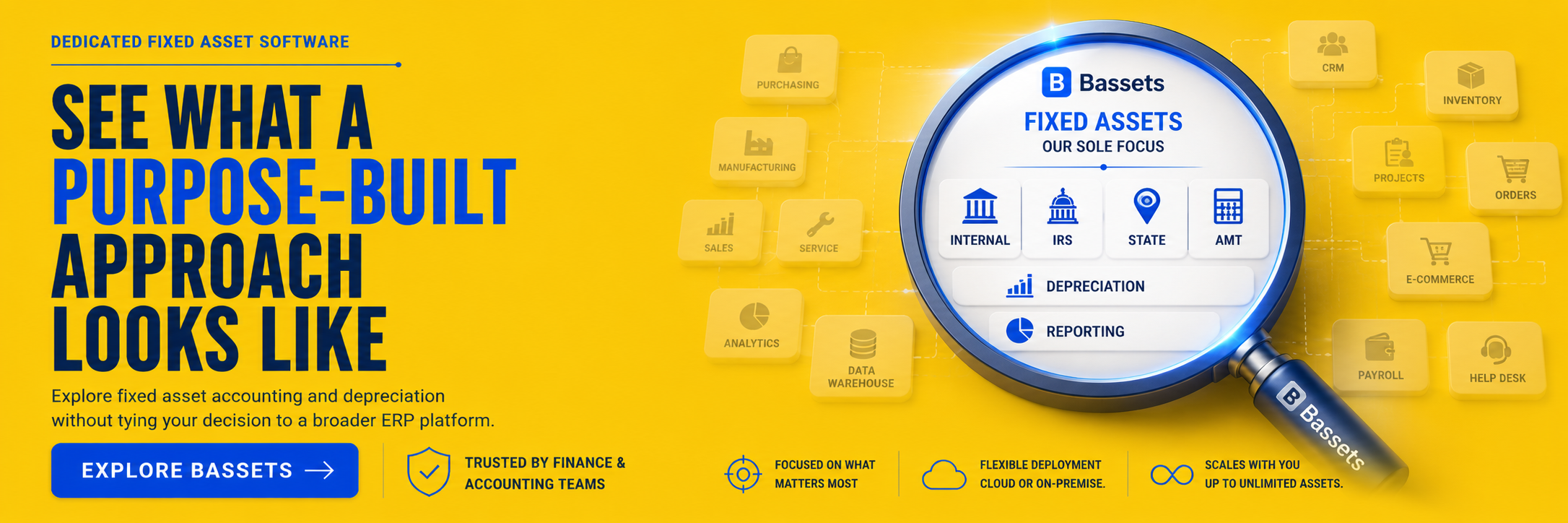
Bassets eDepreciation is dedicated fixed asset accounting and depreciation software for organizations that want fixed asset records, depreciation, lifecycle transactions and reporting managed in a specialist system. It is not a full ERP and should not be positioned as a maintenance-management or CMMS product.
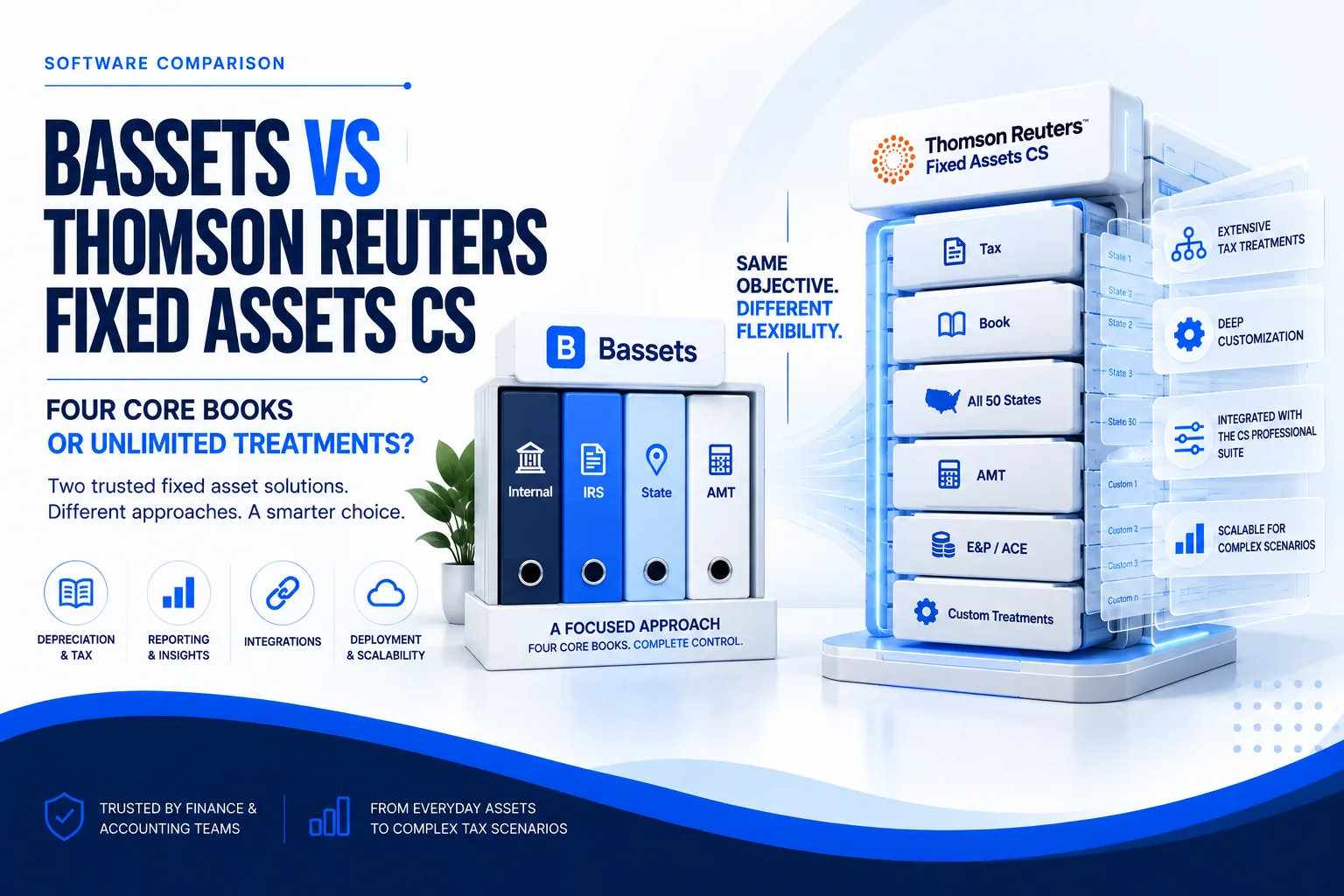
Bassets supports four core depreciation books: Internal, IRS, State and AMT. Users can manage additions, transfers and disposals, run depreciation and reconciliation reporting, and export general ledger depreciation expense data for import into an ERP or accounting system. Compact, Standard and Enterprise licenses support portfolios from up to 5,000 assets through unlimited assets.
Bassets vs NetSuite FAM: Key Differences
1. Dedicated Fixed Asset Software vs an ERP Module
Architecture is the clearest difference between the products. NetSuite FAM is installed and configured within a NetSuite account. Oracle’s setup documentation includes GL accounts, FAM preferences, transfer accounts, depreciation methods, alternate tax methods, asset types and migration as part of the module setup.
Bassets takes a dedicated-system approach. An organization can use it for fixed asset accounting and depreciation without making the fixed asset decision dependent on running NetSuite as its ERP. Neither model is inherently better. Existing NetSuite customers may value keeping asset activity inside the same environment, while organizations evaluating fixed asset software independently may prefer a specialist platform.
2. Depreciation Books and Tax Requirements
Bassets uses four defined core books: Internal, IRS, State and AMT. This gives users a structured way to maintain separate accounting and tax depreciation views.
NetSuite FAM is more configurable in structure. Oracle documents standard and custom depreciation methods, multiple alternate methods for tax reporting and Multi-Book Accounting. Buyers should therefore compare the actual depreciation methods, conventions, books, tax views and posting requirements they use rather than assuming that the product with the larger feature list is automatically the better fit. Our guide to fixed asset management software features provides a practical checklist for that evaluation.
3. Asset Lifecycle Management
Both products extend beyond simply calculating monthly depreciation. Bassets supports additions, transfers, disposals and the reporting required around fixed asset records and depreciation.
NetSuite FAM supports a broad lifecycle that includes asset proposal and creation, depreciation, revaluation, transfer, split, sale, write-off and retirement. Organizations with complex lifecycle requirements should map their recurring transactions and ask each vendor to demonstrate them using realistic asset scenarios.
4. ERP and General Ledger Workflows
NetSuite has the architectural advantage when the objective is to keep fixed assets inside NetSuite. FAM can create assets from NetSuite transactions and post depreciation and asset-related journal activity directly to NetSuite accounts.
Bassets does not currently claim a native NetSuite integration. Its general ledger interface exports depreciation expense data that can then be imported into an ERP or accounting system. Organizations that require automatic operation inside NetSuite should weigh that difference carefully; those comfortable with a controlled downstream GL export may not need the fixed asset system to be embedded in the ERP.
5. Reporting
Bassets supports financial, tax, depreciation and reconciliation reporting designed around fixed asset accounting. This includes historical and projected depreciation analysis and reporting used for accounting and tax workflows.
NetSuite FAM provides reports such as the Asset Register, Asset Summary, Depreciation Schedule and Monthly Depreciation, with filtering and reporting across relevant NetSuite dimensions. The useful comparison is not the number of reports. Buyers should test whether each system can reproduce month-end, year-end, tax, audit and reconciliation outputs without unnecessary manual work.
6. Lease Accounting
Lease accounting is a meaningful point of differentiation. NetSuite FAM includes functionality designed to support lease accounting standards including ASC 842 and IFRS 16. Oracle documents lease records, payments, amortization schedules, journal entries, lease interest and migration of existing lease details.
Comparable lease-accounting functionality is not a core Bassets positioning claim, so organizations that need fixed assets and lease accounting managed together should evaluate NetSuite’s capability closely rather than assuming the platforms are like-for-like.
7. Deployment and System Environment
NetSuite FAM operates within the NetSuite cloud environment. For organizations already standardized on NetSuite, that can reduce the need to introduce a separate application for fixed assets.
Bassets can be deployed on-premise or in a cloud-hosted virtual machine. That gives organizations another operating model when they want a dedicated fixed asset system or have infrastructure and control requirements that do not point toward an ERP-native module. If deployment is a major part of your evaluation, see our guide to cloud-based fixed asset management software.
NetSuite Fixed Assets Pricing vs Bassets Pricing
Pricing transparency is one of the clearer differences during early vendor evaluation. Oracle’s documentation confirms that Fixed Assets Management is an optional module for sale, but a current standardized public FAM price was not verified. Prospective buyers should therefore confirm module, implementation and related costs directly with NetSuite or their implementation partner.
Bassets publishes starting prices for its three license tiers. Published pricing makes initial budgeting easier, but it should not be interpreted as proof that Bassets will have a lower total cost for every organization.
Total cost should also account for implementation, configuration, migration, training, administration and any wider platform requirements. Compare the full operating model rather than headline software price alone.
When NetSuite Fixed Assets May Be the Better Fit
- Your organization already uses NetSuite and wants fixed asset activity embedded in the same ERP environment.
- Asset creation and accounting entries need to flow directly through NetSuite transactions and accounts.
- Lease accounting for standards such as ASC 842 and IFRS 16 is part of the requirement.
- You need configurable depreciation methods, alternate tax methods or Multi-Book workflows within NetSuite.
- You prefer fixed asset management to remain part of the broader NetSuite technology stack.
When Bassets May Be the Better Fit
- You want dedicated fixed asset accounting and depreciation software rather than an ERP add-on.
- You do not want the fixed asset software decision tied to adopting or expanding NetSuite.
- Four core Internal, IRS, State and AMT books align with your depreciation structure.
- You need a choice between on-premise and cloud-hosted virtual machine deployment.
- Published starting prices and defined asset-volume tiers matter during vendor shortlisting.
- You are replacing another fixed asset system and need historical asset and depreciation data converted into the new environment.
Migrating From NetSuite Fixed Assets to Dedicated Fixed Asset Software
A migration from NetSuite FAM should begin with the data and accounting requirements that must survive the move. Inventory the asset master, acquisition and in-service dates, depreciation methods, tax methods, useful lives, residual values, accumulated depreciation, historical depreciation, transfers, disposals, locations, classes, subsidiaries and GL mappings that affect reporting and reconciliation. If you are still building your shortlist, use our guide to choosing fixed asset software to structure the evaluation before migration begins.
Bassets can support conversion of historical asset and depreciation information so the destination system has the records required for accurate calculations going forward. Before migration, reconcile record counts and balances, define the required depreciation books, decide how much history must be retained, map GL outputs and validate sample assets before moving the full portfolio. If lease accounting is currently handled through NetSuite FAM, that requirement should be addressed separately because equivalent Bassets functionality should not be assumed.
Final Verdict: Bassets vs NetSuite Fixed Assets
NetSuite Fixed Assets Management is a strong option for organizations that want fixed assets embedded in the NetSuite environment. Its lifecycle functionality, configurable depreciation, direct relationship with NetSuite accounting and lease capabilities make it more than a basic add-on.
Bassets offers a different operating model: dedicated fixed asset accounting and depreciation software with four core books, published entry pricing, flexible deployment and defined asset-volume licensing. That can be attractive when fixed asset management needs to stand on its own rather than become another component of an ERP implementation.
The right choice comes down to architecture as much as features. Decide whether fixed assets should live inside NetSuite or in a dedicated depreciation platform, then compare both products against the depreciation, reporting, lifecycle, deployment, migration and accounting workflows your organization actually uses. To evaluate Bassets against those requirements, start a 14-day trial or contact Bassets for a product discussion.
Frequently Asked Questions
What are fixed assets in NetSuite?
In NetSuite, fixed assets can be managed through the Fixed Assets Management SuiteApp. The module supports creation and acquisition, depreciation, revaluation, transfers, disposals and retirement, with asset activity connected to the wider NetSuite accounting environment.
What is NetSuite Fixed Assets Management?
NetSuite Fixed Assets Management, or NetSuite FAM, is an optional SuiteApp for managing company-owned and leased assets inside NetSuite. It supports asset lifecycle workflows, depreciation, reporting, tax methods and lease accounting.
Are fixed assets part of NetSuite Financials?
NetSuite provides Fixed Assets Management as an optional module for sale rather than treating the full FAM capability as a standard free feature. Organizations should confirm their current NetSuite licensing and module requirements with NetSuite.
Does NetSuite have a fixed asset module?
Yes. NetSuite Fixed Assets Management is the platform’s fixed asset module/SuiteApp. It supports acquisition, depreciation, revaluation, transfers, disposal, retirement, reporting and other asset workflows.
How much does NetSuite Fixed Assets Management cost?
A current standardized public price for the FAM module was not verified. Buyers should request current pricing and include implementation, configuration, migration and any wider NetSuite requirements when comparing total cost.
What are alternatives to NetSuite Fixed Assets Management?
The right alternative depends on whether you want fixed assets embedded in an ERP or managed in dedicated software. Bassets is one option for organizations focused on fixed asset accounting, depreciation, reporting and lifecycle transactions in a specialist platform. You can also compare Bassets with Sage Fixed Assets or review our Bassets vs Bloomberg Tax Fixed Assets comparison if those platforms are on your shortlist.
Can you migrate from NetSuite Fixed Assets to Bassets?
Bassets can support conversion of historical fixed asset and depreciation data. A migration should define the asset master, depreciation books and methods, historical balances, reporting requirements and GL mappings that need to be preserved.