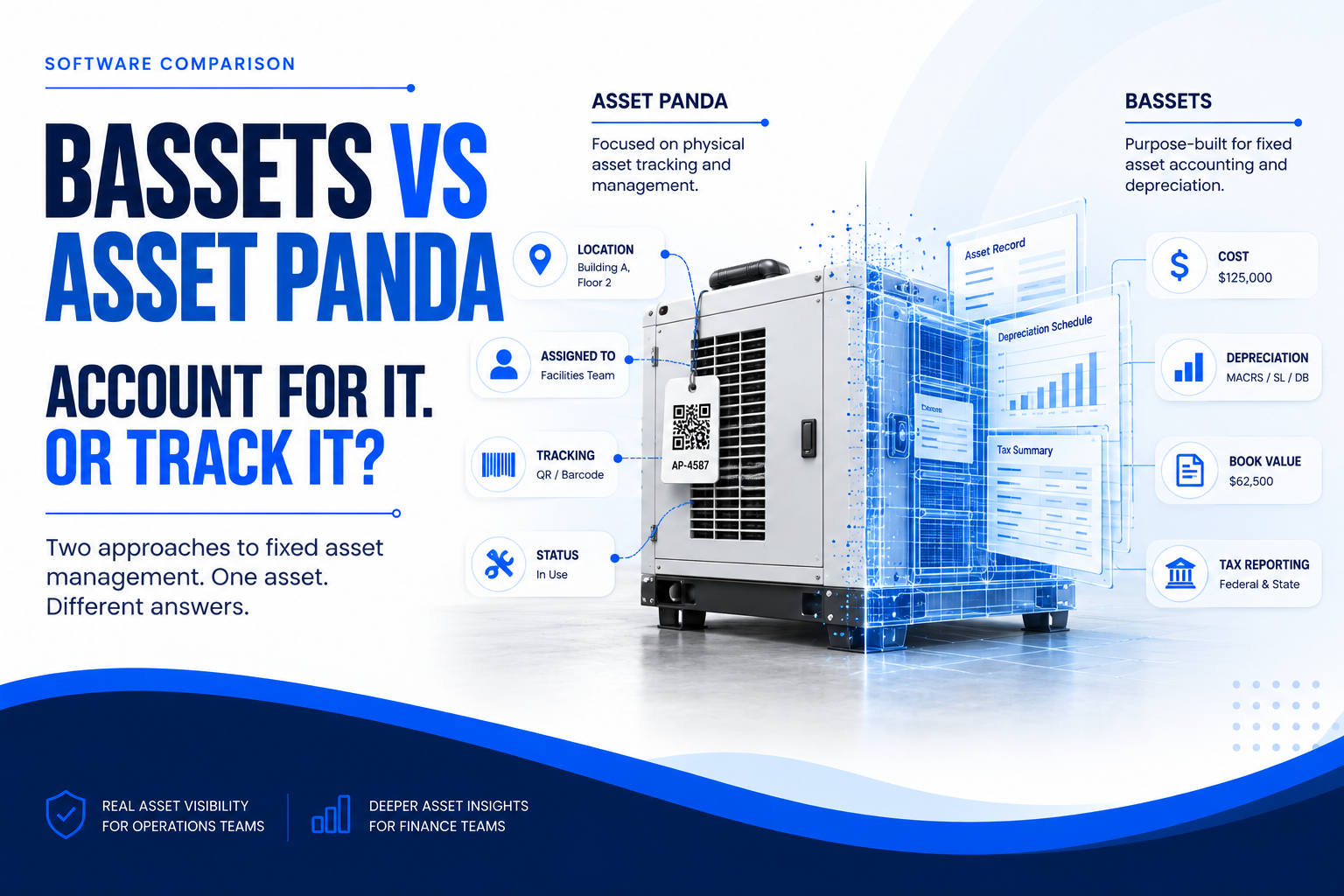
Bassets and Asset Panda Pro can both sit inside a fixed asset management process, but they are built around different priorities. Bassets is centered on fixed-asset accounting, depreciation, tax and financial reporting. Asset Panda Pro is centered on physical asset tracking, mobile workflows and operational visibility, with depreciation capabilities included in the platform.
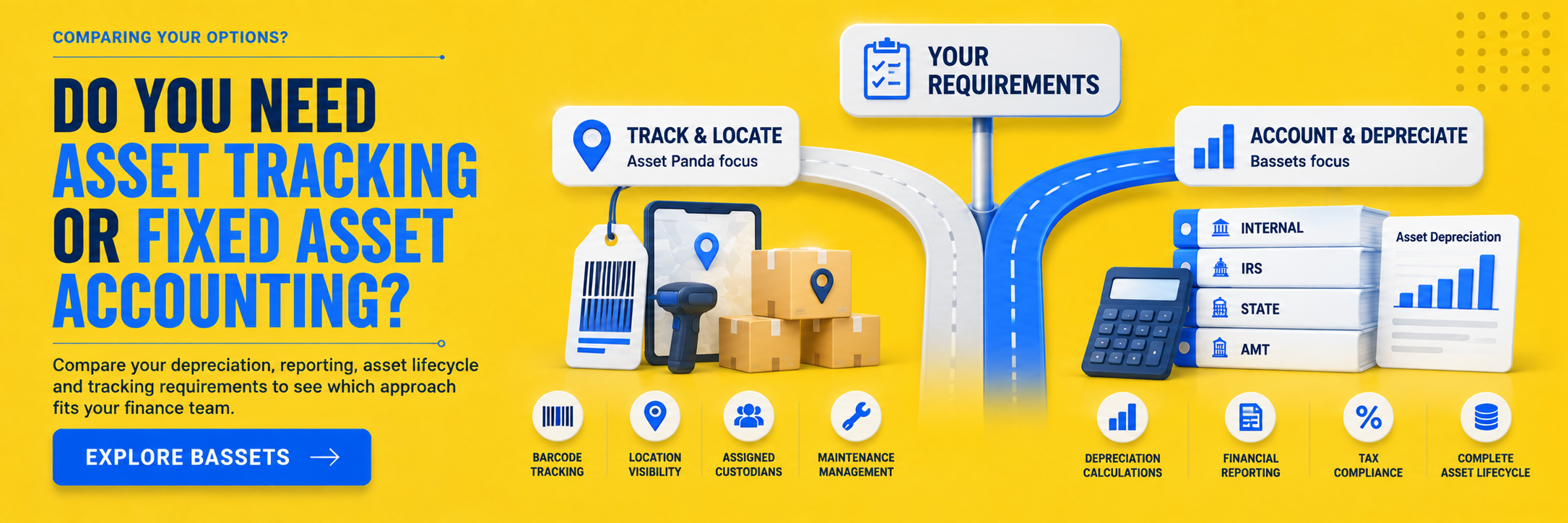
That distinction is more useful than asking which product has the longer feature list. If your biggest challenge is calculating depreciation, maintaining accounting records and producing finance-ready reports, Bassets is likely the closer fit. If your biggest challenge is knowing where equipment is, who has it, when it was scanned and what operational action comes next, Asset Panda Pro is likely the closer fit.
Bassets vs Asset Panda at a Glance
The Biggest Difference: Accounting for Assets vs Tracking Them
The phrase “fixed asset management software” covers more than one type of problem. Finance teams may use it to mean software that calculates depreciation, maintains book and tax records, handles transfers and disposals, and produces reports for close, tax and audit work. Operations or IT teams may use the same phrase for software that tracks where equipment is, who has it, its condition and its maintenance history.
Bassets is designed around the first problem. Asset Panda Pro is designed primarily around the second, although its depreciation functionality means the products now overlap more than a simple accounting-versus-tracking label suggests. Buyers should therefore start by defining the workflows that create the most risk or manual work in their organization. Organizations should consider how to choose fixed asset software that matter most to their accounting and operational workflows before comparing vendors feature by feature.
Depreciation and Fixed Asset Accounting
Bassets makes depreciation a central part of the product. Its current materials describe support for widely used depreciation methods and first-year conventions, MACRS-related validation, bonus depreciation, historical calculations, future projections, transfers, disposals and general-ledger workflows. The platform also supports reporting across past, current and future accounting periods.
Asset Panda Pro has materially expanded its depreciation capabilities. It currently supports straight-line, declining balance, sum-of-years' digits, units of production and double declining balance depreciation. Users can maintain cost, salvage value and useful-life fields, calculate depreciation automatically, and create views and reports around book value, depreciation expense and accumulated depreciation.
The practical distinction is depth and emphasis. Asset Panda Pro can calculate depreciation inside a broader physical asset management platform. Bassets is the stronger fit when depreciation rules, accounting records, tax treatment and finance reporting are the primary reason for buying the system.
Physical Asset Tracking, Barcode and Mobile Workflows
This is where Asset Panda Pro has the clearest advantage. Its mobile application supports barcode and QR-code scanning, asset assignments, check-in/check-out style workflows, GPS pindrops, photos, signatures, inspections and offline activity that syncs when connectivity returns. Those capabilities are valuable when assets move between employees, locations, warehouses, job sites or facilities.
Bassets maintains fixed asset records and supports lifecycle transactions, but it should not be positioned as a substitute for a field-first barcode and mobile audit platform. If the buying requirement begins with “Where is this asset right now?” or “Who has it?”, Asset Panda Pro is the more natural fit.
Asset Lifecycle Management
Both products support the asset lifecycle, but they interpret that lifecycle differently. In Bassets, lifecycle management is closely connected to the accounting record: acquisition, depreciation, transfer, adjustment, partial or complete disposal and the resulting financial reports.
In Asset Panda Pro, lifecycle history is closely connected to operational control: assignment, location, condition, inspection, maintenance, repair, audit activity and eventual disposal. Organizations should map their actual recurring transactions before comparing feature names, because two products can both claim “lifecycle management” while supporting very different day-to-day work.
Reporting and Audit Readiness
Bassets provides more than 20 standard fixed-asset reports, including acquisition, disposal, depreciation detail and summary, depreciation expense journal entry, net asset value, transfer, gain/loss and projection reports. Reports can be generated for historical, current and future periods, exported to common file formats, and extended with SQL report writing.
Asset Panda Pro emphasizes configurable operational reports, dashboards, filters, scheduled reporting and mobile reporting access. Its depreciation functionality also supports custom views and reporting around depreciation expense, accumulated depreciation and book value.
For finance-led reporting, Bassets has the more specialized reporting model. For operational reporting across locations, users, inspections, maintenance and physical inventory, Asset Panda Pro is stronger.
Integrations and Data Exchange
Asset Panda Pro advertises more than 30 native integrations, including Workday, Jamf, DocuSign, Zapier, Xero, Oracle NetSuite, Microsoft Entra ID, Intune, QuickBooks and others. It also promotes custom ERP integrations. This is a meaningful advantage for organizations that want asset data connected across HR, IT, service-management and business systems.
Bassets should not compete on integration count. Its relevant strength is the financial data workflow: importing and reconciling fixed-asset data, exporting depreciation and asset information, producing GL-oriented output and exporting reports to formats such as Excel, PDF, Word and RTF. Buyers should decide whether they need a broad operational integration ecosystem or a controlled accounting-data workflow.
Cloud, On-Premise and Mobile Access
Asset Panda Pro is a cloud platform designed around web and mobile access. Its mobile application is a major part of the product experience and includes offline workflows for environments without reliable connectivity.
Bassets gives organizations another approach to cloud-based fixed asset management software, with deployment choices across its product editions. That can matter to organizations that want dedicated fixed-asset software but have specific infrastructure, access or deployment requirements. If mobile field work is central, Asset Panda Pro has the stronger proposition; if deployment flexibility around a finance-focused system matters more, Bassets deserves closer consideration.
Bassets vs Asset Panda Pricing
The pricing models are different enough that a headline price comparison can be misleading. Bassets currently publishes starting prices for its Compact, Standard and Enterprise editions, with the editions scaling by asset volume and capabilities. Its website also offers a 14-day evaluation with no credit card required.
Asset Panda Pro uses personalized pricing. Its current quote page says organizations receive a custom quote based on their needs and offers a free 7-day trial after the demo process. Asset Panda's own comparison content also describes its pricing as customized rather than a fixed public tier price.
When comparing cost, include the workflows each product may replace. A lower software price is not necessarily lower total cost if the organization still needs separate processes for physical audits, tax depreciation, reporting, integrations or reconciliation.
Who Should Choose Bassets?
Bassets is the stronger candidate when fixed assets are primarily a finance, accounting or tax-management problem. That includes organizations that need deeper depreciation calculations, repeatable financial reporting, historical and projected depreciation, GL workflows, data conversion and a dedicated fixed-asset accounting environment.
It is also worth considering when the organization wants fixed asset software to stand on its own rather than adopting a broader physical asset tracking or IT asset management platform.
Who Should Choose Asset Panda Pro?
Asset Panda Pro is the stronger candidate when physical visibility and operational control are the priority. Organizations with assets moving between employees, sites or field locations can benefit from barcode and QR scanning, mobile audits, GPS data, assignments, offline workflows, inspections, maintenance and a broad integration ecosystem.
It can also suit organizations that want depreciation available within the same operational asset platform and whose accounting requirements fit the depreciation methods and reporting it supports.
Can Bassets and Asset Panda Replace Each Other?
Sometimes, but not always. There is enough overlap that either platform may satisfy a straightforward fixed asset process, particularly where the organization needs a central asset register plus depreciation. But the products are not interchangeable at the edges of their capabilities.
An organization with complex depreciation, tax and finance-reporting requirements should not assume that an operational asset tracker will replace dedicated fixed-asset accounting software without testing those requirements. Likewise, an organization that relies on mobile scanning, physical audits, GPS/location data and maintenance workflows should not assume that accounting-led software will replace a field-oriented tracking platform.
In some environments, the real decision may not be “Bassets or Asset Panda?” but whether the organization needs one system to cover its dominant requirement or separate systems for financial and operational asset management.
Bassets vs Asset Panda: Final Verdict
Bassets and Asset Panda Pro solve different versions of the fixed asset management problem. Bassets is purpose-built around depreciation, fixed-asset accounting and finance reporting. Asset Panda Pro is purpose-built around physical asset visibility and operational workflows, while also providing depreciation functionality.
Choose Bassets when the financial treatment of fixed assets is the central requirement. Choose Asset Panda Pro when tracking the physical asset, including its location, custodian, condition and operational history, is the central requirement. If your organization needs both, test the most complex workflows on each side before deciding which system, or combination of systems, best fits the process.
Still comparing fixed asset software? Explore our broader fixed asset software comparison, or see how Bassets compares with Sage Fixed Assets, Bloomberg Tax Fixed Assets and NetSuite Fixed Assets Management.
To see how Bassets handles your own depreciation, reporting and fixed-asset accounting requirements, start a 14-day evaluation and test it with representative asset data before making a decision.
Frequently Asked Questions
Is Asset Panda a fixed asset management system?
Yes. Asset Panda Pro manages asset records, lifecycle history, physical tracking, reporting and depreciation. Its strongest differentiation is operational asset visibility through mobile, barcode/QR, assignment, audit and workflow capabilities.
Does Asset Panda calculate depreciation?
Yes. Asset Panda Pro automatically calculates depreciation after depreciation is enabled and the required asset values are entered.
What depreciation methods does Asset Panda support?
Asset Panda Pro currently supports five methods: straight line, declining balance, sum-of-years' digits, units of production and double declining balance.
What is the difference between Bassets and Asset Panda?
Bassets is centered on fixed-asset accounting, depreciation, tax and financial reporting. Asset Panda Pro is centered on physical asset tracking, mobile workflows and operational visibility, with depreciation included.
Is Bassets an alternative to Asset Panda?
It can be when the buyer's primary requirement is fixed-asset accounting and depreciation. It is not a like-for-like replacement for Asset Panda Pro's mobile barcode scanning, GPS, inspections and operational tracking workflows.
Which is better for fixed asset depreciation: Bassets or Asset Panda?
Bassets is the stronger fit for organizations with deeper accounting, tax depreciation and finance-reporting requirements. Asset Panda Pro can be sufficient when its five depreciation methods meet the organization's needs and depreciation is part of a broader physical asset workflow.
Which is better for barcode asset tracking: Bassets or Asset Panda?
Asset Panda Pro is the stronger choice for barcode and QR-code tracking because scanning, mobile audits, assignments and offline field workflows are core parts of its product.