Bloomberg Tax Fixed Assets, formerly BNA Fixed Assets, and Bassets eDepreciation both support fixed asset depreciation, but they approach the problem differently. Bloomberg emphasizes tax automation and complex state depreciation, while Bassets focuses on fixed asset accounting, depreciation, reporting and lifecycle workflows with published starting prices and flexible deployment.
Bassets vs Bloomberg Tax Fixed Assets at a Glance
What Is Bloomberg Tax Fixed Assets, Formerly BNA Fixed Assets?
Bloomberg Tax Fixed Assets is a cloud-based fixed asset subledger designed to calculate and manage depreciation with a strong emphasis on tax requirements. The product is the current Bloomberg offering associated with the legacy BNA Fixed Assets name, which remains important because finance and tax professionals still search for and reference the older brand.
Bloomberg's proposition is particularly relevant where tax complexity drives the fixed asset process. Its materials emphasize depreciation calculations based on current tax laws, state depreciation, tax and financial differences, and tools for evaluating bonus-depreciation scenarios. That makes it a serious option for organizations whose fixed asset requirements extend well beyond a basic book-depreciation schedule.
What Is Bassets eDepreciation?
Bassets eDepreciation is fixed asset accounting and depreciation software for finance, accounting and tax teams. It centralizes asset records, depreciation calculations, lifecycle transactions and reporting in a dedicated system rather than trying to serve as a full ERP or maintenance-management platform. For a broader view of the capabilities finance teams should evaluate, see 10 fixed asset management software features.
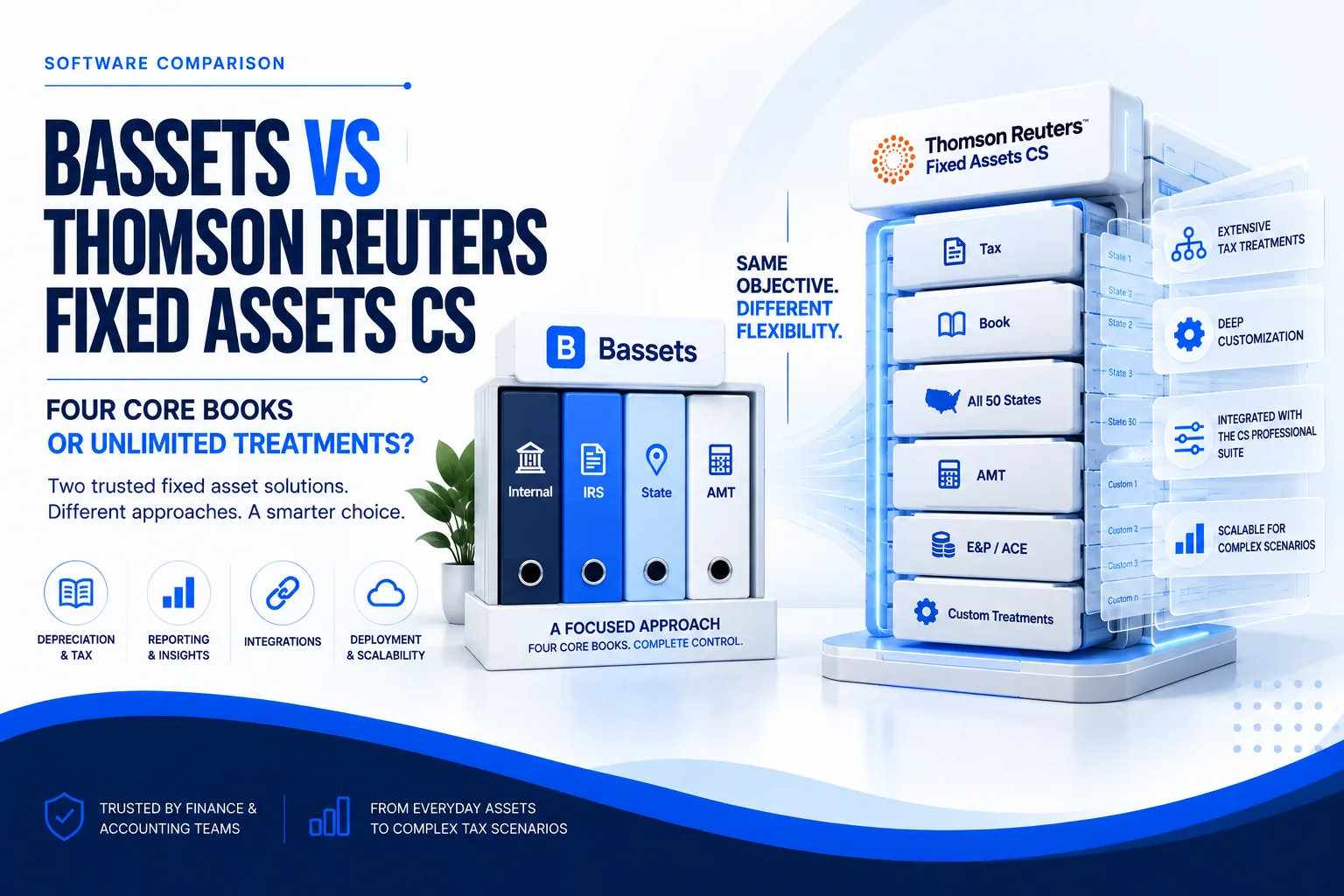
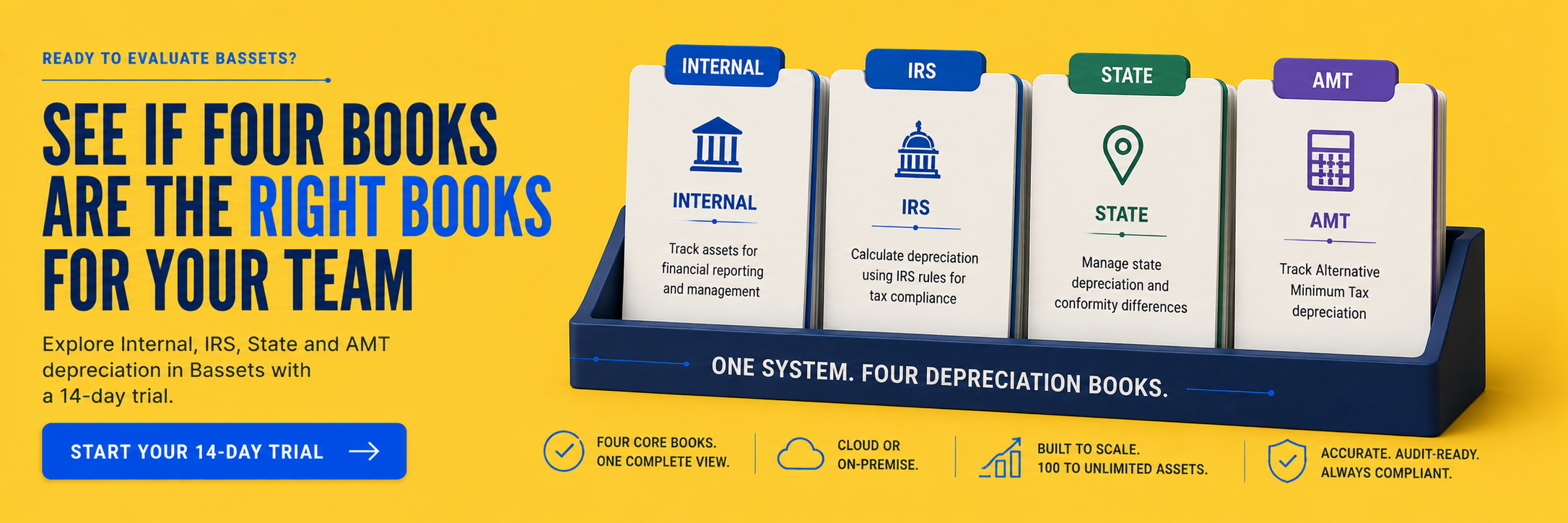
Bassets supports four core depreciation books: Internal, IRS, State and AMT. Organizations can manage additions, transfers and disposals, generate depreciation and reconciliation reports, and export general ledger expense data for import into ERP or accounting systems. Its Compact, Standard and Enterprise licenses are designed for portfolios ranging from up to 5,000 assets to unlimited assets.
Bassets vs Bloomberg Tax Fixed Assets: Key Differences
1. Depreciation and Fixed Asset Accounting
Both platforms are designed to move depreciation work out of fragile spreadsheet processes, but the emphasis differs. Bassets is centered on the accounting lifecycle of fixed assets, including asset records, depreciation, transfers, disposals, reporting and general ledger outputs. This makes the product especially relevant to Controllers, accounting teams and finance departments looking for a dedicated fixed asset system.
Bloomberg positions Fixed Assets as a tax-oriented subledger. Depreciation is part of a wider tax technology proposition, with particular attention to keeping calculations aligned with tax requirements. For organizations where tax departments own much of the fixed asset process, that distinction may be valuable.
2. Federal and State Tax Depreciation
State depreciation is one of Bloomberg's clearest strengths. State conformity can create differences between federal and state depreciation, particularly around bonus depreciation and adjusted basis. Bloomberg specifically promotes State Depreciation functionality designed to handle those differences and support reconciliation.
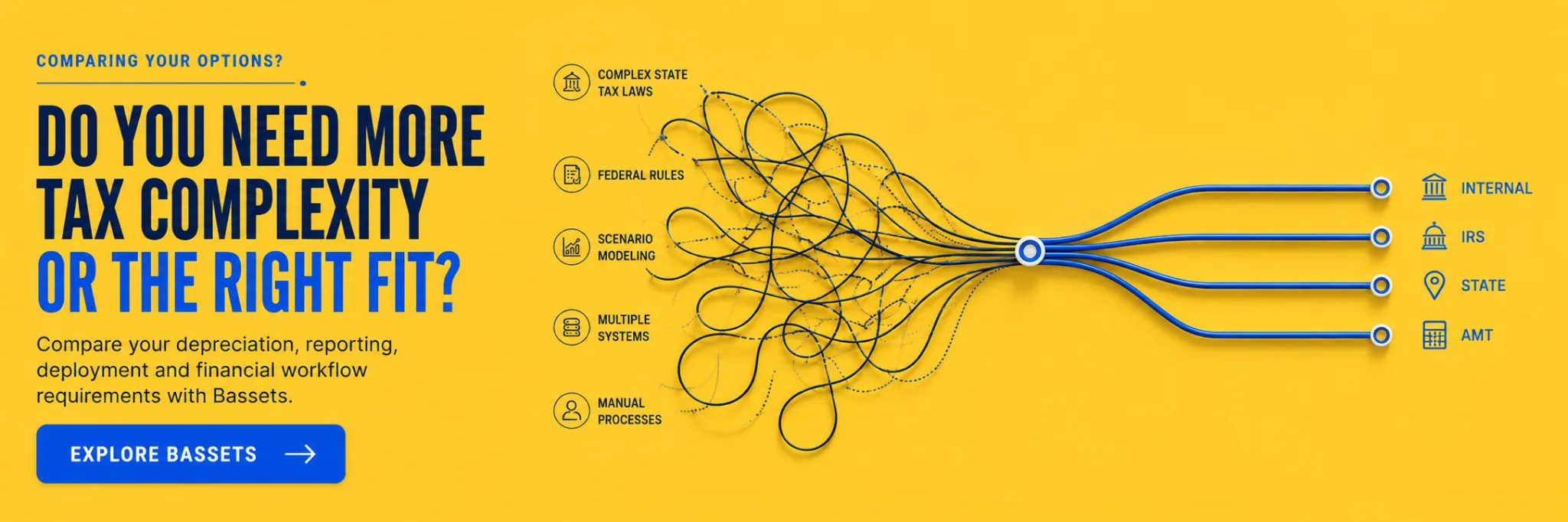
Bassets provides dedicated IRS, State and AMT books alongside the Internal book. That gives finance teams a structured way to maintain separate depreciation views without presenting Bassets as a broader tax research or tax automation suite. Buyers with highly complex multi-state tax requirements should therefore examine the depth of each system against their actual filing footprint rather than comparing only whether a State book exists.
3. Depreciation Books and Scenario Requirements
Bassets uses four core books: Internal, IRS, State and AMT. That structure is straightforward and maps directly to common finance and tax reporting requirements.
Bloomberg supports multiple depreciation books and publicly demonstrates workflows spanning federal, AMT, state and other tax perspectives. Bloomberg also promotes bonus-depreciation scenario modeling, allowing tax teams to evaluate alternatives before applying a strategy. Organizations that require numerous specialized tax views or extensive what-if modeling should investigate Bloomberg's configuration depth during a demo.
4. Reporting and Financial Workflows
Reporting should be evaluated around the decisions and reconciliations your team actually performs. Bassets supports depreciation analysis, historical and projected calculations, tax and financial reporting, and reconciliation workflows. Its dedicated depreciation software platform is designed around fixed asset records and their accounting impact.
Bloomberg's reporting sits within a tax-led environment and can be attractive to teams that want fixed asset data connected with broader tax workflows. Neither product should be selected on the number of reports alone. Ask whether the software can reproduce your month-end, year-end, tax and audit outputs without excessive manual manipulation.
5. Integrations and General Ledger Workflows
This is an area where buyers need to distinguish an integration from an export. Bassets does not claim native third-party integrations. Its general ledger interface exports depreciation expense data that can then be imported into an ERP or accounting system. That can work well for teams comfortable with a controlled downstream file workflow, but organizations requiring automatic bidirectional synchronization should evaluate that limitation carefully.
Bloomberg positions Fixed Assets within a more connected tax technology environment and supports integration and implementation services. If native or automated connectivity is a major buying criterion, ask Bloomberg to demonstrate the exact systems, data flows, frequency and controls supported in your proposed configuration.
6. Deployment
Bloomberg Tax Fixed Assets is cloud-based. Bassets can be deployed on-premise or in a cloud-hosted virtual machine environment. The better model depends on your IT policies, remote-access requirements and preference for infrastructure control. Our cloud-based fixed asset management software guide explains why deployment should be evaluated alongside security, migration, reporting and finance workflows rather than in isolation.
Bloomberg Tax Fixed Assets Pricing vs Bassets Pricing
Pricing transparency is one of the clearest differences during early-stage evaluation. Bloomberg directs prospective Fixed Assets buyers to request pricing rather than publishing a standard price on its pricing request page. That does not mean Bloomberg will necessarily cost more. It means buyers need a quote before they can make a direct budget comparison.
Bassets publishes starting prices. Current Bassets pricing starts at $9.99 per user per month for Compact, $19.99 for Standard and $29.99 for Enterprise. Compact supports up to 5,000 assets, Standard up to 20,000 and Enterprise unlimited assets. A 14-day trial is available with no credit card required.
Headline price is only one part of total cost. Buyers should also compare implementation, migration, training, integration work, support and internal administration. See our fixed asset software comparison for a broader framework.
Is Bassets a Bloomberg Tax Fixed Assets Alternative?
Yes, Bassets can be considered as an alternative when the requirement is primarily fixed asset accounting, depreciation, lifecycle transactions and reporting. It is not a like-for-like replacement for every Bloomberg tax workflow. The more important question is which capabilities your organization actually uses.
If your team needs four core depreciation books, structured fixed asset accounting, general ledger expense export, defined asset-volume tiers and a choice between on-premise and cloud-hosted deployment, Bassets deserves evaluation. If your requirements depend on deeper state-tax automation, extensive tax scenario modeling or tight alignment with a broader Bloomberg Tax environment, Bloomberg may be the stronger fit.
When Bloomberg Tax Fixed Assets May Be the Better Fit
- Your organization has complex federal and multi-state depreciation requirements.
- State conformity and bonus-depreciation differences create significant recurring tax work.
- Tax teams need scenario modeling as part of depreciation planning.
- You prefer a cloud-based product embedded in a broader tax technology environment.
- Your integration requirements align with capabilities Bloomberg can demonstrate for your existing systems.
When Bassets May Be the Better Fit
- You want a dedicated fixed asset accounting and depreciation system rather than a broader tax technology suite.
- Published starting prices are important during budgeting and vendor shortlisting.
- Four core Internal, IRS, State and AMT books match your reporting structure.
- You need on-premise or cloud-hosted virtual machine deployment flexibility.
- You want support for asset portfolios ranging from thousands of records to unlimited assets by license tier.
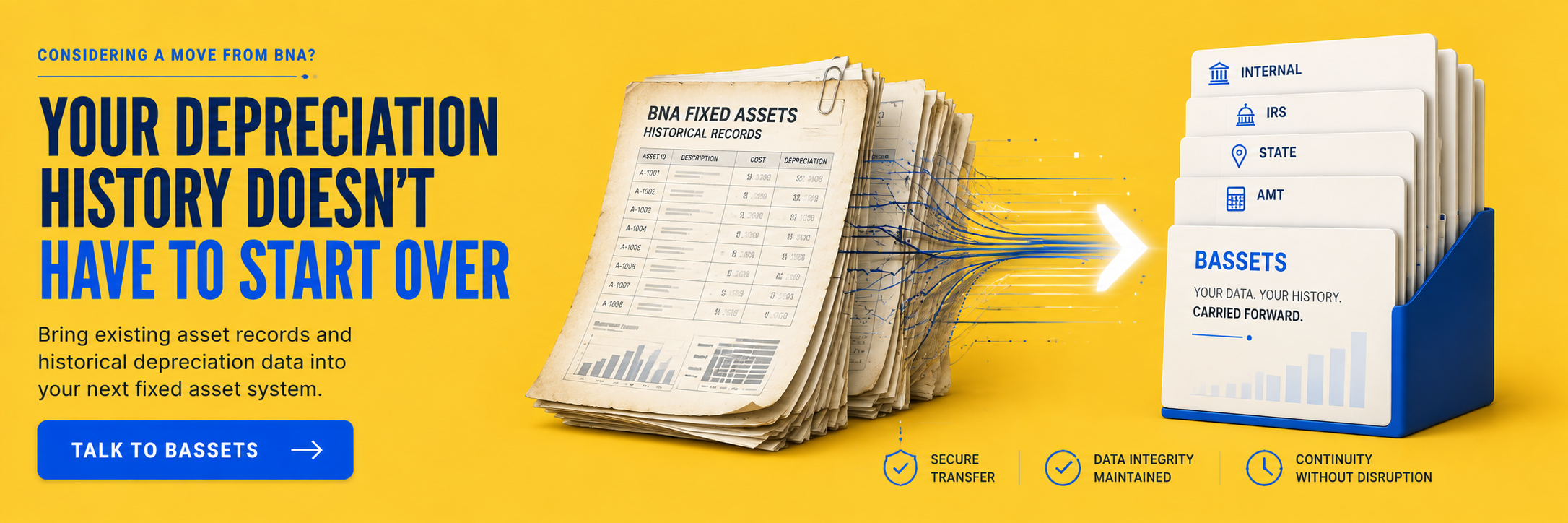
- You are replacing another fixed asset system and need historical asset and depreciation data converted into the new environment.
Migrating From BNA Fixed Assets to Bassets
A BNA Fixed Assets replacement project should begin with the data, not the new interface. Before migration, inventory the asset master, depreciation books, historical depreciation, methods, conventions, placed-in-service dates, accumulated depreciation, disposals, transfers and the fields required for reconciliation.
Bassets can support data conversion of existing fixed asset and historical depreciation information so the new system has the information needed to calculate depreciation accurately going forward. Before committing to any migration, validate record counts, required books, historical depth, reporting outputs and GL mapping. Our guide to selecting fixed asset software provides a broader evaluation framework.
How to Evaluate a BNA Fixed Assets Replacement
Do not evaluate a replacement only by matching feature names. Build a short requirements matrix around the processes that create the most financial or tax risk today. Include depreciation methods and books, state requirements, asset volume, month-end reporting, tax reporting, audit history, GL workflows, deployment, user access, migration and support.
Then ask each vendor to demonstrate those workflows using scenarios that resemble your environment. A focused system with fewer headline features may be the better choice if it handles your recurring processes cleanly. A deeper tax platform may justify additional complexity if your organization genuinely needs those capabilities.
Final Verdict: Bassets vs Bloomberg Tax Fixed Assets
Bloomberg Tax Fixed Assets is a strong option for tax-intensive organizations, particularly where federal and state depreciation complexity, tax-law-driven calculations and scenario modeling are central to the fixed asset process. Bassets takes a more focused approach to fixed asset accounting and depreciation, with four core books, published entry pricing, flexible deployment and scalable asset-volume licensing.
The right choice depends on the work your team needs the software to perform. If you are evaluating BNA Fixed Assets alternatives, compare both systems against your actual depreciation books, state-tax requirements, reporting workflows, integration expectations and migration needs.
Frequently Asked Questions
Is BNA Fixed Assets now Bloomberg Tax Fixed Assets?
Bloomberg Tax Fixed Assets is the current Bloomberg product associated with the legacy BNA Fixed Assets name. Because many finance and tax professionals still use the older name, both terms remain relevant when researching the product or evaluating replacements.
How much does Bloomberg Tax Fixed Assets cost?
Bloomberg does not publish a standard Fixed Assets price on its public pricing request page. Prospective buyers are directed to request pricing. Compare any quote with implementation, migration, integration, training, support and administration costs rather than subscription or license cost alone.
What are alternatives to Bloomberg Tax Fixed Assets?
Alternatives depend on the requirement. Bassets is one option for organizations focused on fixed asset accounting, depreciation, reporting and lifecycle transactions. Sage Fixed Assets, ERP-native fixed asset modules and other specialist systems may also be relevant depending on integration, tracking and tax needs.
Can you migrate from BNA Fixed Assets to Bassets?
Bassets can support conversion of existing fixed asset records and historical depreciation data. A migration should first define the asset master, depreciation books, historical balances, methods, conventions, reporting requirements and GL mappings that need to be preserved.
Does Bloomberg Tax Fixed Assets support state depreciation?
Yes. Bloomberg specifically promotes State Depreciation functionality for handling state conformity differences, adjusted basis and depreciation calculations where state rules diverge from federal treatment.
How does Bassets compare with Bloomberg Tax Fixed Assets?
Bassets is a focused fixed asset accounting and depreciation platform with four core books, published starting prices and on-premise or cloud-hosted deployment. Bloomberg is a cloud-based, tax-led fixed asset subledger with deeper emphasis on tax automation, state depreciation and scenario modeling