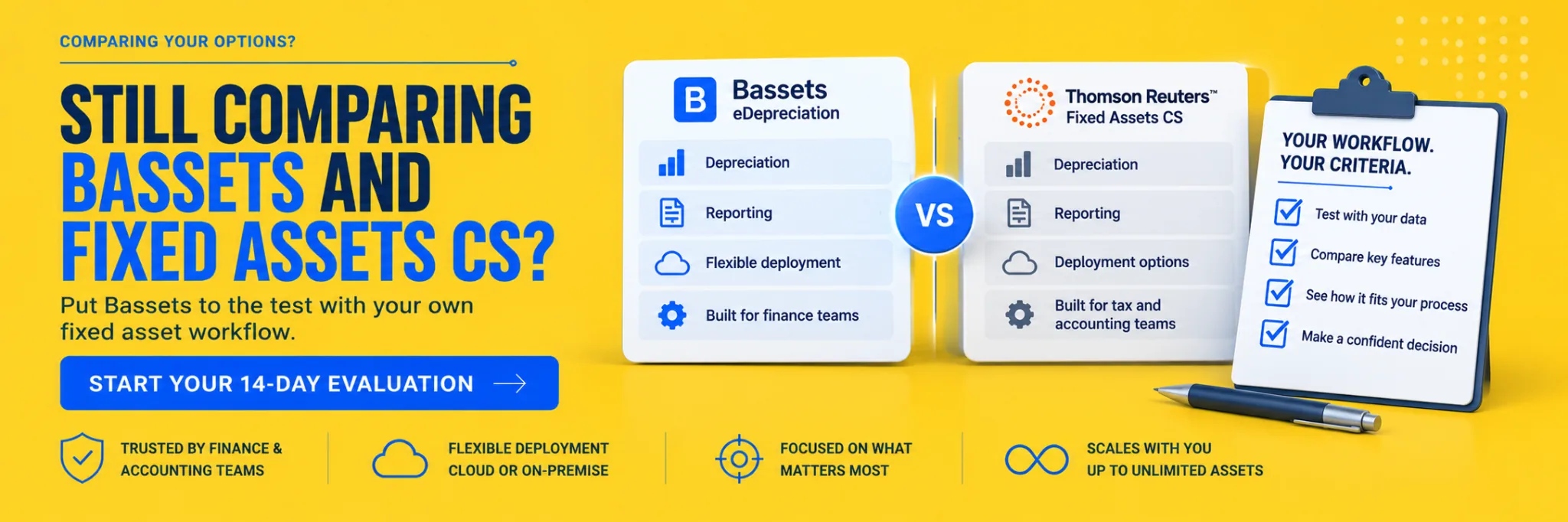
Bassets and Thomson Reuters Fixed Assets CS are both purpose-built for fixed asset accounting and depreciation, but they organize the work differently. Fixed Assets CS emphasizes extensive depreciation treatments, custom configuration and close connections with the Thomson Reuters CS Professional Suite. Bassets combines depreciation, lifecycle transactions, reporting and general ledger workflows in a dedicated fixed asset environment that can operate independently of a specific tax or ERP ecosystem.
For finance, accounting and tax teams, the decision is less about which product has the longer feature list and more about which architecture matches the way the organization works. This comparison looks at depreciation, reporting, integrations, deployment, pricing and buyer fit. For a broader framework before comparing vendors, see 10 fixed asset management software features finance teams should look for.
Bassets vs Fixed Assets CS at a Glance
What Is the Difference Between Bassets and Thomson Reuters Fixed Assets CS?
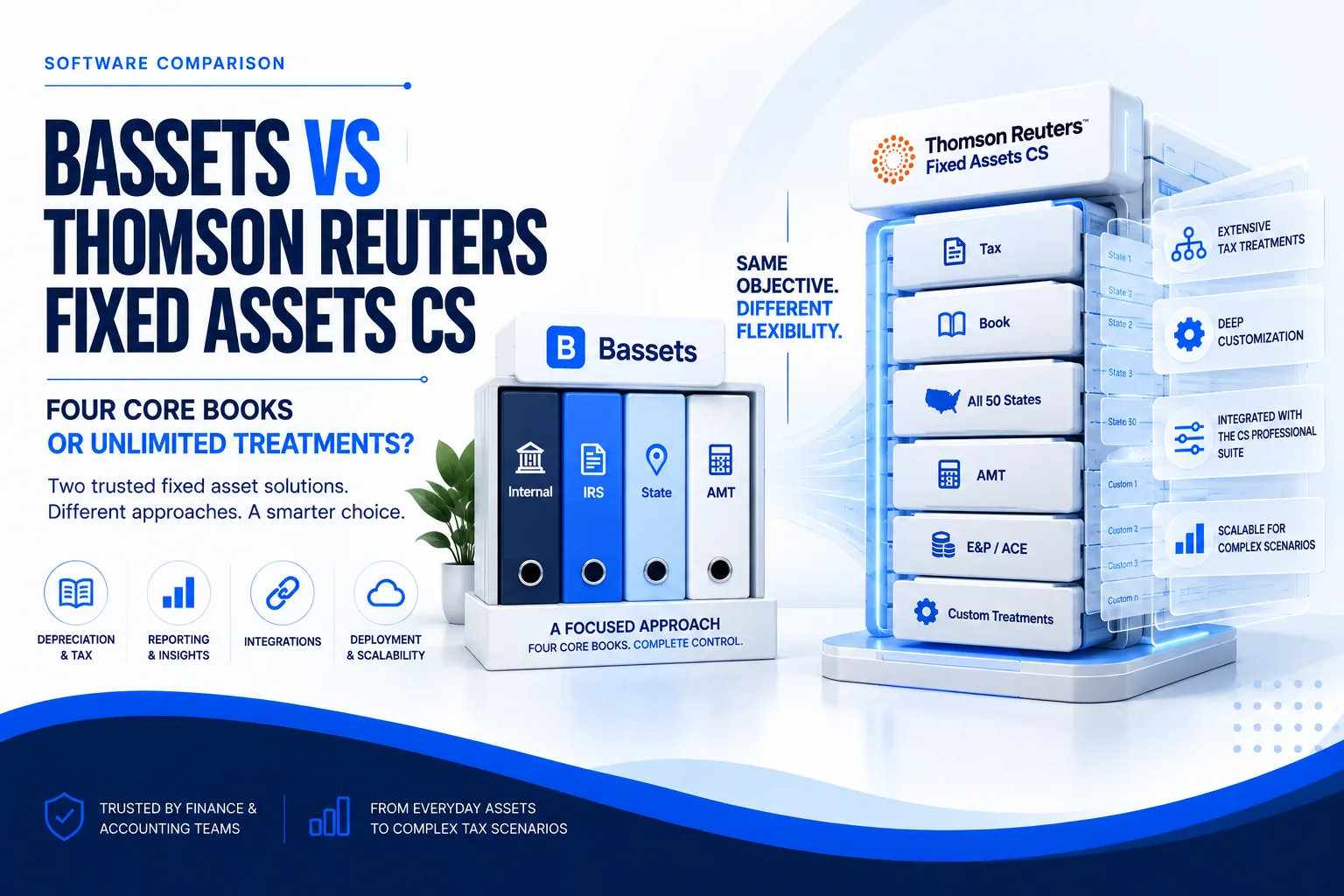
Bassets and Fixed Assets CS are both fixed asset depreciation platforms, but their workflows differ. Fixed Assets CS offers a highly configurable treatment structure and deep integration with Thomson Reuters tax and accounting applications. Bassets uses four core depreciation books and is designed to function as a dedicated fixed asset system without requiring a particular tax or ERP ecosystem.
Bassets centers the fixed asset process on asset records, depreciation calculations, transfers, disposals, reporting and general ledger outputs. Its eDepreciation platform is available in editions that scale from smaller portfolios to unlimited assets.
Fixed Assets CS takes a more treatment-heavy approach. Thomson Reuters documents Tax, Book, all 50 states, AMT, State AMT, earnings and profits, ACE, State ACE and unlimited custom treatments. Its value increases further for firms already using products such as UltraTax CS and Accounting CS.
Bassets vs Fixed Assets CS for Depreciation
Bassets depreciation structure
Bassets uses four core depreciation books: Internal, IRS, State and AMT. The platform supports common tax and financial depreciation requirements, including MACRS, ADS, straight-line and declining-balance methods, Section 179 calculations, bonus depreciation and historical or future-period calculations. The defined book structure can suit teams that want separate financial, federal, state and AMT views without building a large number of custom treatments.
The system also connects depreciation with asset transactions. Teams can process complete or partial transfers and disposals while retaining the fixed asset record and its accounting history. For background on how depreciation fits into the wider asset lifecycle, see Bassets' fixed asset management process flow.
Fixed Assets CS depreciation treatments
Fixed Assets CS provides substantially more treatment configurability. Thomson Reuters states that the software can calculate an unlimited number of treatments, including federal and state treatments, and automatically calculate federal and state depreciation differences where applicable. Its feature documentation also covers annual, quarterly and monthly depreciation and prior fiscal-year or short-year handling.
This depth matters when a tax practice or corporation maintains numerous depreciation views across clients, jurisdictions or specialized reporting requirements. It also means buyers should distinguish between needing more configuration and simply having more configuration available.
Which depreciation approach fits your organization?
Choose based on the complexity you actually need. Fixed Assets CS has the stronger proposition when numerous tax treatments, custom treatments and state-specific depreciation views are central to the workflow. Bassets is compelling when Internal, IRS, State and AMT books cover the required structure and the team values a defined fixed asset accounting environment.
If you are comparing depreciation functionality more broadly, Bassets' guide to fixed asset accounting software explains how multi-book calculations, lifecycle transactions and reporting fit into the accounting process.
How Do Bassets and Fixed Assets CS Handle the Asset Lifecycle?
Both products extend beyond calculating a depreciation schedule. Bassets supports additions, transfers, disposals, depreciation and reporting within the same fixed asset record. Fixed Assets CS supports adding, changing, disposing and transferring assets, with wizards for disposal, method/life and associations.
The practical evaluation should focus on the transactions your team performs repeatedly. Ask each vendor to demonstrate a new acquisition, a partial transfer, a disposal, a method change and the resulting depreciation and reporting outputs. A feature list cannot show how much manual intervention those transactions require in your environment.
Reporting and Fixed Asset Data
Bassets reporting
Bassets provides more than 20 standard fixed asset reports, including acquisition, disposal, inventory, depreciation detail, depreciation summary, journal entry, transferred asset and multi-year projection reports. Reports can cover past, current and future accounting periods, with sorting and selection controls, SQL report writing and exports to common document and spreadsheet formats.
Fixed Assets CS reporting
Fixed Assets CS also has substantial reporting depth. Thomson Reuters allows users to create custom reports using selected columns, special values, formulas and custom-treatment variables. The product documentation states that users can create an unlimited number of custom reports.
Neither product should be selected on report count alone. During evaluation, reproduce the reports used for month-end close, tax preparation, audit support, asset reconciliation and budgeting. The better reporting system is the one that produces those outputs with the least recurring manipulation.
Integrations and General Ledger Workflows
Fixed Assets CS and the CS Professional Suite
This is one of Fixed Assets CS's clearest differentiators. Thomson Reuters documents direct workflows with Accounting CS, UltraTax CS, FileCabinet CS and Practice CS. Fixed Assets CS journal entries can be imported into Accounting CS, while asset information and depreciation data can be shared with UltraTax CS when client setup requirements are met.
Thomson Reuters also supports Excel import and export and other file-based data exchanges. For tax practices already centered on the CS Professional Suite, these connections can reduce system boundaries and duplicate data handling.
Bassets and the general ledger
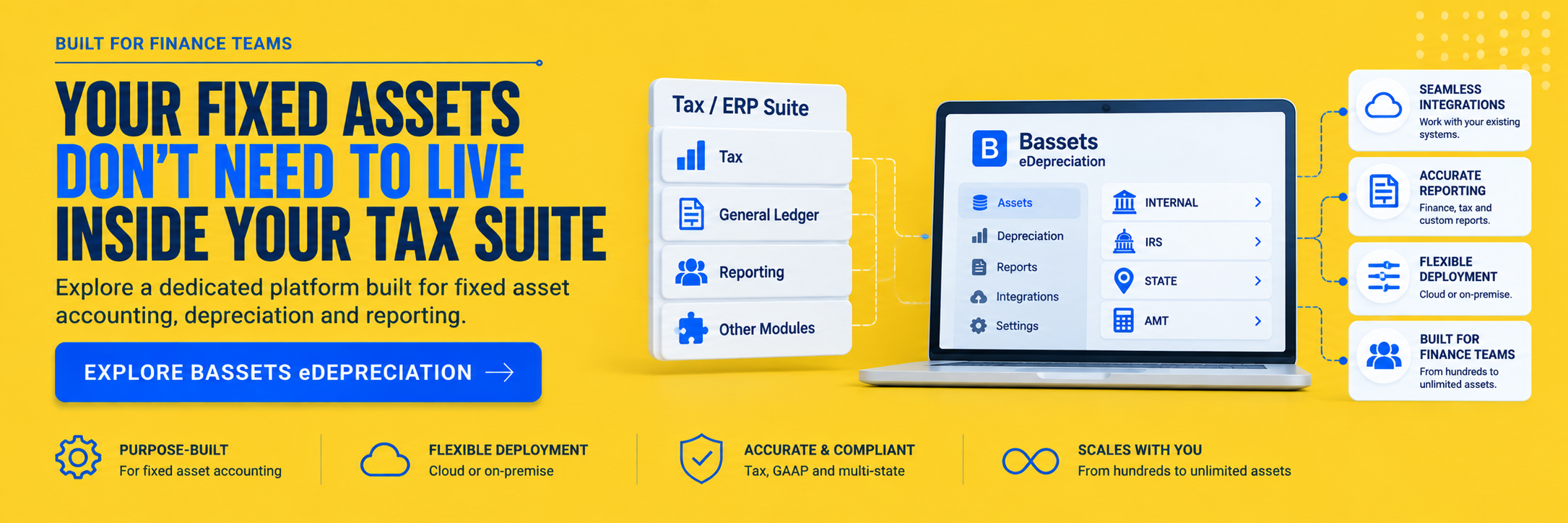
Bassets takes a more independent approach. Its general ledger workflow is based on exporting depreciation expense data for import into the organization's ERP or accounting system rather than requiring the fixed asset platform to live inside one vendor ecosystem. This can suit teams that want a dedicated fixed asset subledger while retaining their existing finance stack.
The trade-off is important: a controlled export/import process is not the same as a native application integration. If automated bidirectional synchronization is a requirement, buyers should test the exact data flow rather than treating every connection as equivalent.
Deployment, Scalability and Implementation
Bassets offers deployment flexibility and publishes asset-volume tiers. It currently lists Compact for up to 5,000 assets, Standard for up to 20,000 assets and Enterprise for unlimited assets. Bassets also supports software setup and conversion of existing asset data, which is important when replacing a legacy depreciation system.
Fixed Assets CS can be installed in a local environment and is also supported in Thomson Reuters hosted environments. Thomson Reuters documentation for Virtual Office CS and SaaS includes mapped program and client-data locations for Fixed Assets CS.
Deployment should therefore be evaluated alongside IT ownership, remote access, security requirements, migration and support rather than reduced to a simple cloud-versus-desktop label. Bassets' cloud-based fixed asset management software guide provides a broader checklist for that decision.
Bassets vs Fixed Assets CS Pricing
Bassets currently publishes starting prices of $9.99 per user per month for Compact, $19.99 for Standard and $29.99 for Enterprise. The Bassets pricing page also offers a 14-day evaluation with no credit card required.
Thomson Reuters' Fixed Assets CS product page directs prospective buyers to contact sales rather than displaying a standard public Fixed Assets CS price. That does not mean Fixed Assets CS will necessarily cost more. It means buyers need a quote before making a direct budget comparison.
Compare total cost, not only license price. Include migration, implementation, hosting, integrations, training, support, additional software required for the intended workflow and the internal time needed to administer the system.
When Should You Choose Bassets?
- You want dedicated fixed asset accounting and depreciation software that is not dependent on a specific tax or ERP suite.
- Internal, IRS, State and AMT books fit your depreciation and reporting structure.
- You want published starting prices during the vendor-shortlisting stage.
- You need asset-volume options ranging from up to 5,000 assets to unlimited assets.
- A controlled GL expense export and downstream import fits your accounting workflow.
- You want to test the system with representative asset data before committing.
Organizations still building their shortlist can also use Bassets' fixed asset software comparison to compare dedicated depreciation products with ERP-native and physical asset-tracking approaches.
When Should You Choose Thomson Reuters Fixed Assets CS?
- Your organization or CPA firm already relies heavily on UltraTax CS, Accounting CS or other CS Professional Suite applications.
- You need a large number of depreciation treatments or custom treatments.
- Federal and state depreciation differences create substantial recurring work.
- Client-based tax workflows are central to how fixed asset data is maintained.
- You need highly configurable custom reporting using treatment variables, formulas and client-specific layouts.
For CPA firms specifically, the decision should include how fixed asset data moves into the tax workflow. Bassets also supports accounting firms and CPAs with depreciation calculations and reporting, so compare the actual client workflows rather than assuming one product fits every practice. See Bassets for accounting firms and CPAs.
Bassets vs Fixed Assets CS: Final Decision
There is no universal winner. Fixed Assets CS is a strong fit for tax and accounting environments that need extensive treatment configurability and benefit from close integration with the Thomson Reuters CS Professional Suite. Bassets is a strong fit for finance and accounting teams that want a dedicated fixed asset platform with four core books, lifecycle transactions, reporting, published entry pricing and independence from a particular tax or ERP ecosystem.
The best evaluation uses your own hardest workflows. Test state and federal depreciation, month-end journal entries, transfers, disposals, audit reports, historical data conversion and the exact integration or export process your team will use. The product that handles those recurring tasks cleanly is the better fit for your organization.
Frequently Asked Questions
What is Thomson Reuters Fixed Assets CS used for?
Fixed Assets CS is fixed asset and depreciation accounting software used to add, change, transfer and dispose of assets, calculate depreciation across multiple treatments, and produce fixed asset reports. It is particularly relevant to tax and accounting teams that use the Thomson Reuters CS Professional Suite.
Does Fixed Assets CS integrate with UltraTax CS?
Yes. Thomson Reuters documents data sharing between Fixed Assets CS and UltraTax CS when client IDs and data paths are configured appropriately. Depreciation data can be transferred to UltraTax CS, and Fixed Assets CS reports can also be included in UltraTax CS print workflows.
Can Fixed Assets CS calculate state depreciation?
Yes. Thomson Reuters states that Fixed Assets CS supports all 50 states and can automatically calculate federal and state depreciation differences where applicable.
What is the main difference between Bassets and Fixed Assets CS?
Fixed Assets CS emphasizes extensive depreciation treatments, custom configuration and Thomson Reuters ecosystem integration. Bassets uses four core books and provides fixed asset accounting, lifecycle, reporting and GL workflows in an independent dedicated platform.
Which fixed asset software is better for CPA firms?
Fixed Assets CS may be especially attractive to CPA firms already using UltraTax CS or other CS Professional Suite applications. Bassets can also support CPA depreciation and reporting workflows. The better choice depends on treatment complexity, client workflow, integrations, reporting and whether the firm wants its fixed asset system tied to a particular tax software ecosystem.