Fixed asset management software is a finance system for controlling the accounting lifecycle of long-term assets, from acquisition and placed-in-service through depreciation, transfers, reporting, and disposal. For CFOs, Controllers, Tax Managers, and CPAs, the strongest platforms connect asset records with depreciation rules, multiple books, GL outputs, audit history, and repeatable reporting rather than treating fixed assets as a simple inventory list.
The evaluation is more important in 2026 because depreciation requirements continue to change. The IRS' 2025 Publication 946 covers MACRS, Section 179, special depreciation allowances, and the distinction between GDS and ADS, while also listing 2026 Section 179 limits. Finance teams therefore need software that can preserve the underlying tax and book logic and support changes without rebuilding schedules manually.
The most important fixed asset management software features for finance teams include:
- Automated depreciation calculations
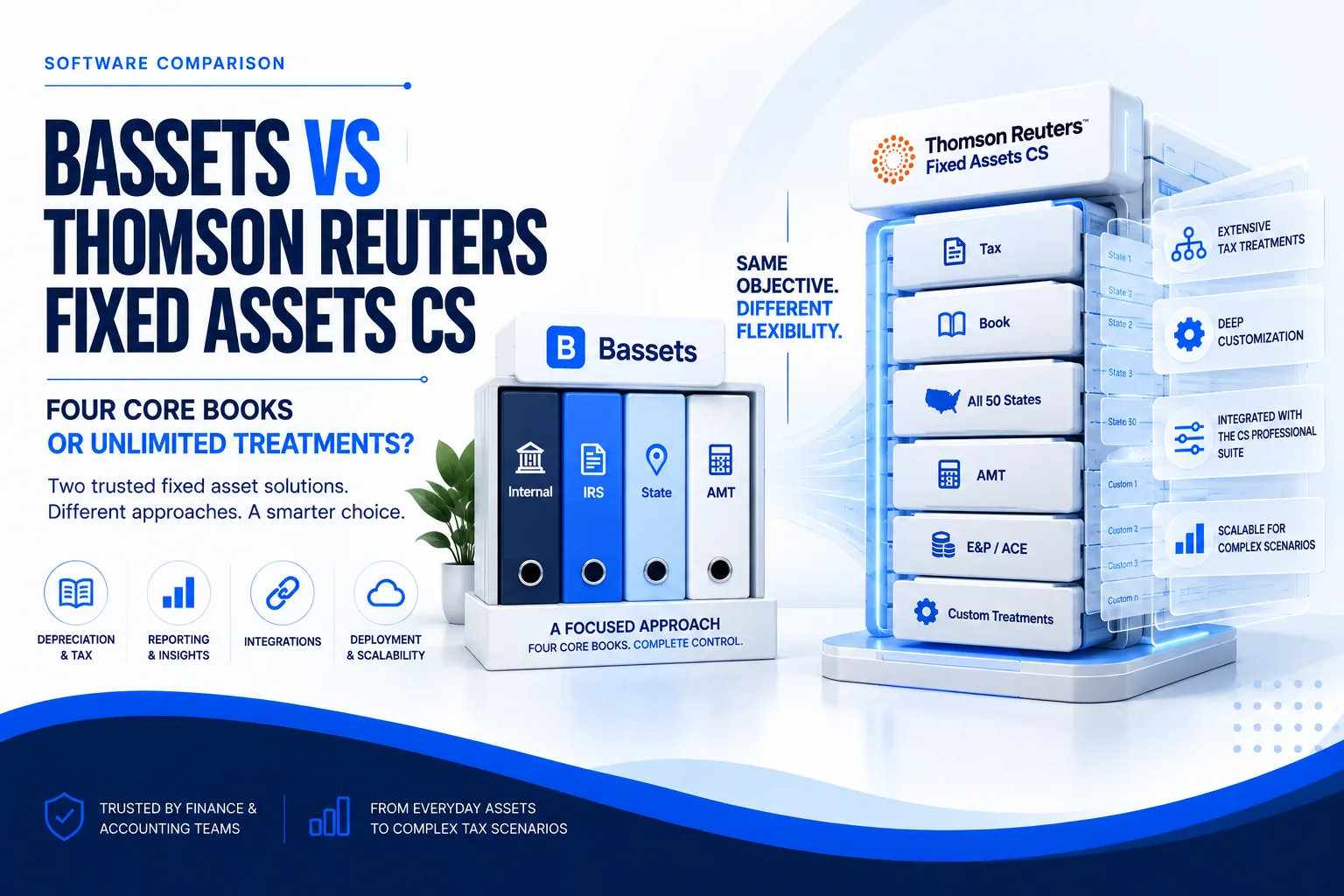
- Multiple depreciation books and tax treatments
- Complete asset lifecycle management
- Fixed asset inventory and tracking controls
- Finance-grade reporting and projections
- General ledger data exchange and reconciliation
- Data validation and audit-ready history
- Data migration and historical conversion
- Scalability without a future migration project
- Specialist support, updates, and configuration
What Is Fixed Asset Management Software?
Fixed asset management software helps finance teams maintain accurate records for long-term assets throughout their lifecycle, from acquisition and placement in service through depreciation, transfers, and disposal. It centralizes asset cost, location, useful life, depreciation method, tax treatment, and other accounting information in one system.
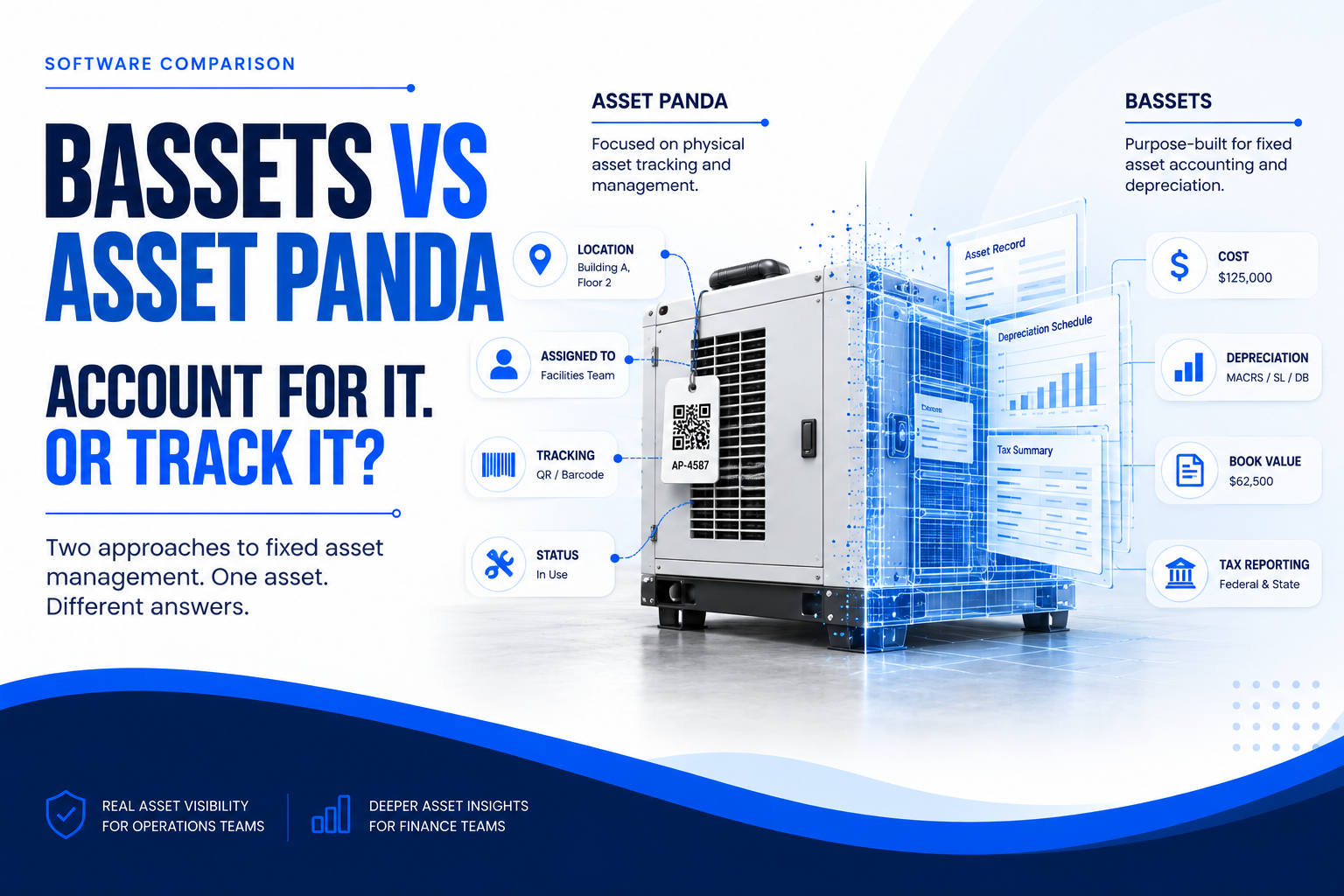
Unlike basic asset tracking tools that primarily record an asset’s location or custodian, fixed asset management software also supports the financial side of asset management, including depreciation calculations, tax books, reporting, reconciliation, and audit documentation.
Fixed asset software is often used as shorthand for fixed asset management software, particularly when the focus is on accounting, depreciation, tax reporting, and financial controls. Some platforms also include broader asset management capabilities such as physical asset tracking, transfers, inventory management, and lifecycle reporting.
When Have You Outgrown Your Current Fixed Asset Process?
A spreadsheet can be adequate for a small, stable asset population. The warning signs appear when the process becomes dependent on manual reconciliations, duplicated schedules, individual spreadsheet owners, or workarounds that are difficult to review.
- Book, federal, state, or management depreciation schedules are maintained separately and reconciled manually.
- Transfers, adjustments, partial disposals, and retirements require offline calculations or manual journal entries.
- Close, tax, or audit reports are rebuilt from multiple files instead of reproduced from one governed asset record.
- Historical data is difficult to explain because changes, assumptions, or prior calculations are not consistently preserved.
- The asset population or number of business units has grown beyond the controls that worked when the process was smaller.
These are process-risk signals, not universal asset-count thresholds. A tax-complex portfolio of a few hundred assets can justify dedicated fixed asset accounting software sooner than a much larger but simpler portfolio.
Fixed Asset Management Software: Finance Evaluation Checklist
1. Automated Depreciation Calculations
Automated depreciation calculations help finance teams calculate book and tax depreciation consistently while maintaining the assumptions and asset-level records behind each calculation.
Depreciation is the financial capability that separates purpose-built fixed asset software from a basic asset register. The system should calculate historical, current-period, and future depreciation consistently while preserving the inputs that produced each result. Finance teams should be able to review basis, life, method, convention, placed-in-service date, accumulated depreciation, and subsequent adjustments without reverse-engineering a spreadsheet.
For US portfolios, test the methods and tax treatments used in your real asset population. Bassets eDepreciation supports common and less common calculations, including Straight Line, Remaining Life, MACRS, alternative MACRS, declining balance, Section 179 and bonus depreciation, among other U.S. depreciation methods.
What to test: select representative assets from different classes and placed-in-service periods, reproduce the current schedule, then change a valid input and confirm the resulting calculation and history are understandable.
2. Multiple Depreciation Books and Tax Treatments
Tax depreciation and multi-book support allow finance teams to maintain different depreciation treatments for financial reporting, tax, and other reporting requirements without maintaining separate asset records.
Finance teams may need separate depreciation views for financial reporting, federal tax, state tax, or other management requirements. Fixed asset software should allow those treatments to coexist around the same underlying asset without forcing the team to maintain disconnected files.
This matters because tax depreciation is not static. IRS Publication 946 explains that MACRS includes both GDS and ADS, which can require different methods and recovery periods. A finance team should therefore verify the exact books, methods, conventions, elections, and jurisdictional treatments its portfolio requires rather than accepting a generic claim that software 'handles tax.'
What to test: run one asset through the book and tax treatments your team maintains, then compare basis, life, method, convention, accumulated depreciation, and projected expense across the books.
3. Complete Asset Lifecycle Management
Asset lifecycle controls help finance teams accurately record additions, transfers, and disposals so changes to fixed assets are reflected consistently in depreciation, reporting, and accounting records.
A reliable fixed asset record should preserve the financial story from acquisition through retirement. That includes placed-in-service, transfers, adjustments, improvements, changes in classification, partial disposals, full disposals, and any other events that affect cost, basis, depreciation, or reporting.
Construction in progress deserves particular attention because capitalization and placed-in-service timing can affect when depreciation begins. Construction-in-progress management helps finance teams track project costs before assets are placed in service and transfer those costs accurately into depreciable fixed assets when projects are completed. Lifecycle controls should make it possible to trace what changed, when it changed, and how the event affected subsequent depreciation and reporting.
Bassets 6x includes a dedicated Construction in Progress (CIP) capability that allows users to maintain asset invoices during the construction phase, consolidate invoices when construction is complete, and transfer completed projects to in-service assets through a simplified workflow.
What to test: process a transfer, an adjustment, a partial disposal, and a full disposal. Confirm that the software updates depreciation correctly and retains a reviewable transaction history.
4. Fixed Asset Inventory and Tracking Controls
Fixed asset inventory and tracking controls help finance teams maintain accurate records of each asset’s location, department, custodian, and physical status while keeping those records connected to the accounting system.
Accounting records are only as reliable as the asset population behind them. Fixed asset tracking software should help finance reconcile the register to physical assets, locations, departments, custodians, and transfers without creating a separate shadow inventory process.
Bassets offers barcode-based inventory capabilities as part of its fixed asset platform. For organizations with multiple sites or significant physical portfolios, connecting inventory verification to the accounting record can support cleaner disposals, location changes, and asset verification.
What to test: choose assets from more than one location, verify how physical inventory results update or reconcile to the financial record, and review how exceptions are handled.
5. Finance-Grade Reporting and Projections
Finance-grade reporting and projections help finance teams turn fixed asset data into repeatable outputs for close, tax, audit, budgeting, and management review without rebuilding reports manually.
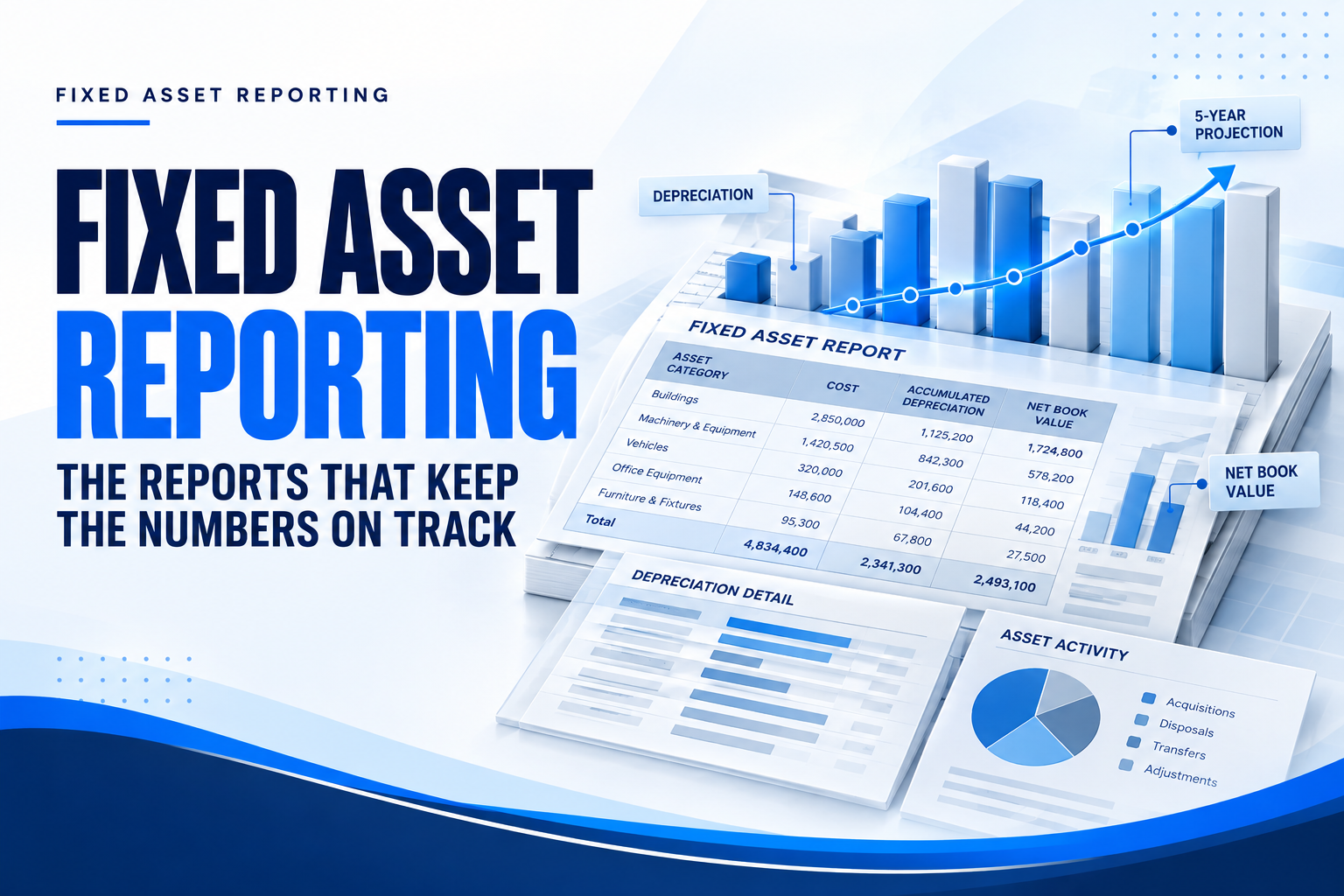
Reporting should answer recurring finance questions without rebuilding the data each month. Look for depreciation detail and summaries, acquisitions, disposals, gain or loss, transferred assets, journal entries, projections, and flexible filtering and export options.
Bassets provides more than 20 standard reports and supports SQL report writing for additional flexibility. Its platform also supports historical depreciation reporting and future projections, which can be useful for close preparation, budgeting, tax planning, and audit support.
Good fixed asset reporting software should let finance reproduce close, tax, audit, and management outputs from the same governed asset data. The test is not how many reports appear on a feature list, but whether the reports answer your recurring review questions with minimal offline manipulation.
6. General Ledger Data Exchange and Reconciliation
General ledger data exchange and reconciliation help finance teams keep fixed asset activity aligned with the accounting system by transferring journal data accurately and making it easier to reconcile asset balances to the general ledger.
Efficient GL data exchange should reduce manual re-entry without weakening reconciliation controls. During evaluation, ask how fixed asset data is imported, how depreciation journal entries are exported, how account structures are mapped, and how exceptions or changes are reviewed before posting.
Bassets supports GL-compatible data exports, allowing fixed asset and depreciation information to be prepared for use within an organization's general ledger workflow. The value of that output depends on how well the export structure aligns with the organization's account structure and reconciliation process.
What to test: generate a depreciation journal entry from representative data, map it to the GL structure, and reconcile the totals back to the fixed asset reports used during close.
7. Data Validation and Audit-Ready History
Audit trails and change history give finance teams a traceable record of changes to fixed asset data, helping them verify what changed, when it changed, and maintain stronger controls during audits and financial close.
Audit readiness depends on being able to reproduce what happened to an asset and explain why. Finance teams should look for validation at data entry, consistent classifications, transaction history, repeatable reports, and controls that make unusual or incomplete records easier to identify.
Bassets lists automatic depreciation-schedule validation as a platform capability. Validation is particularly relevant when errors in method, life, convention, basis, or tax treatment could propagate across hundreds or thousands of records. Bassets 6x also includes Audit History that can be reviewed by user, time and action, giving finance teams greater visibility into activity within the system and supporting more traceable review processes.
What to test: deliberately introduce an invalid or incomplete record, review how the system flags it, correct the record, and confirm that the final reporting and history remain understandable.
8. Data Migration and Historical Conversion
Data migration and historical conversion help finance teams move existing fixed asset records into a new system while preserving the cost, depreciation, and historical information needed for accurate reporting and continuity.
A fixed asset software migration succeeds only when historical cost, accumulated depreciation, dates, methods, lives, conventions, and adjustments reconcile. A fast import that carries forward bad data creates a cleaner interface around the same control problem.
Bassets supports conversion from spreadsheets and other fixed asset management software. A credible migration plan should cover field mapping, exception handling, validation, opening-balance reconciliation, testing, and sign-off before the old process is retired.
What to test: migrate a representative sample that includes older assets, fully depreciated assets, transfers, and prior adjustments. Reconcile beginning balances and current depreciation before assessing speed or convenience.
9. Scalability Without a Future Migration Project
Scalable fixed asset software allows finance teams to accommodate growing asset volumes, additional entities, and more complex reporting requirements without having to replace the system or undertake another major data migration.
Scalability is more than an asset-count claim. Finance teams should compare asset limits, user limits, reporting performance, business-unit structures, data-conversion options, and whether the same platform can support increasing complexity as the organization grows.
Bassets currently offers Compact for up to 5,000 fixed assets, Standard for up to 20,000, and Enterprise with unlimited fixed asset records. This creates a path from smaller portfolios to larger environments without changing the core fixed asset platform.
Bassets can also support fixed asset management across multiple business locations and multiple companies under the same owner or brand, allowing organizations to manage more complex asset structures as they grow.
What to test: ask the vendor what changes as your asset population, entities, users, reporting requirements, and tax complexity increase. The answer should cover both technical capacity and implementation effort.
10. Specialist Support, Updates, and Configuration
Specialist support, regular software updates, and flexible configuration help finance teams adapt their fixed asset system as accounting requirements, tax rules, workflows, and organizational needs change over time.
Fixed asset software sits close to financial reporting and tax compliance, so support matters after implementation. Evaluate setup assistance, data conversion, product updates, technical support, training, and the vendor's ability to understand depreciation questions rather than only software tickets.
Bassets states that purchases include a dedicated technical account manager and that its services cover setup, data conversion, annual software updates, and technical support. That specialist model can be particularly useful for teams replacing long-standing spreadsheets or legacy fixed asset systems.
What to test: ask who supports implementation, how tax or product updates are delivered, what happens when a calculation requires investigation, and which services are included versus separately scoped.
How to Test Fixed Asset Software During a Demo
A feature checklist narrows the field, but a finance-led proof of concept should use representative company data. A polished demo can make almost any platform look capable; the better test is whether it can reproduce the transactions and outputs your team relies on.
- Import a representative sample of historical assets and reconcile beginning cost and accumulated depreciation.
- Run the same asset through the book, federal, state, or other depreciation treatments your team maintains.
- Process an acquisition, transfer, adjustment, partial disposal, and full disposal, then inspect the transaction history.
- Generate the reports used during close, tax preparation, audit, forecasting, and management review.
- Export a depreciation journal entry and reconcile it to the general ledger structure.
- Introduce an exception or invalid record and observe how validation, review, and correction work.
- Ask the vendor to demonstrate how historical conversion, support, updates, and scaling would work for your environment.
Fixed Asset Software vs. Spreadsheets
How to Compare Fixed Asset Software Without Getting Distracted by Feature Counts
Feature lists can make competing platforms look more similar than they are. Finance teams should compare depth, control, and repeatability rather than counting checkmarks. A vendor may technically support depreciation, reporting, integrations, and disposals, but the important question is whether those capabilities work with the methods, books, transaction volumes, approval practices, and reporting outputs your organization uses.
Start with the workflows that create the most review effort today. If month-end depreciation requires spreadsheet adjustments, test the calculation and reconciliation process. If tax schedules are the pain point, test book-to-tax differences, methods, conventions, elections, and projections. If audit support is slow, test how quickly the system can reproduce an asset's history, supporting transactions, and the reports used to substantiate balances.
The same principle applies to fixed asset software for accountants and CPA firms. Client portfolios can differ substantially in asset classes, tax treatments, reporting requirements, and historical data quality. A platform should be evaluated against representative complexity, not a sanitized demo company that avoids the edge cases staff will eventually have to manage.
Finally, distinguish between a feature that exists and a feature that reduces work. Ask how many steps a recurring task requires, what must still happen outside the system, and what evidence remains available after the task is complete. That approach gives Controllers and Finance Directors a more useful basis for comparison than a generic software scorecard.
What Good Fixed Asset Software Looks Like in Practice
For a Controller, good software shortens the path from asset activity to a reconciled close. For a Tax Manager, it preserves the depreciation treatments and supporting data needed to calculate and review tax positions. For a CPA, it makes schedules easier to validate, reproduce, and explain across clients or reporting periods.
The common denominator is controlled reuse of the same asset data. When acquisitions, depreciation, transfers, disposals, reports, and GL outputs depend on separate manual schedules, every handoff creates another point of review. Purpose-built software should reduce those handoffs while keeping the calculations and transaction history accessible.
Why Bassets Fits a Finance-Led Evaluation
Bassets eDepreciation is positioned around fixed asset management, depreciation, reporting, and finance workflows. Its current product information includes flexible data conversion, more than 20 standard reports, SQL report writing, automatic schedule validation, GL-compatible data exports, historical reporting, future projections, transfers and disposals, and editions that scale from smaller portfolios to unlimited fixed asset records.
Bassets 6x further strengthens finance controls with customizable user access and Audit History by user, time and action, while its CIP functionality supports the transition of construction costs into in-service fixed assets.
That focus is relevant to finance teams that need more depreciation depth than a basic accounting package but do not want fixed asset management buried inside a broader ERP implementation. Product fit still depends on the organization's books, tax treatments, reporting, integrations, controls, and migration requirements, which is why the demo should be tested against real data.
Take Control of Fixed Asset Management and Depreciation
Growing asset portfolios make depreciation, reporting, tax treatments, reconciliation, and asset history harder to manage through disconnected schedules. Bassets gives finance teams a dedicated fixed asset platform with scalable editions, depreciation calculations, reporting, data conversion, validation, GL-compatible data exports, and specialist support.

Frequently Asked Questions About Fixed Asset Management Software
What is fixed asset management software?
Fixed asset management software helps finance teams manage the financial and operational records of fixed assets throughout their lifecycle. It can support depreciation calculations, tax books, asset tracking, transfers, disposals, reporting, reconciliation, and audit documentation in a centralized system.
What features should CFOs and Controllers prioritize in fixed asset software?
Prioritize depreciation depth, multiple books, lifecycle history, finance reporting, GL data exchange, validation, migration controls, scalability, and specialist support. Test each capability against the transactions and reports used in your actual close, tax, audit, and management processes.
What is the difference between fixed asset management software and fixed asset tracking software?
Fixed asset management software focuses on the financial and accounting management of assets, including depreciation, tax reporting, reconciliation, disposals, and audit records. Fixed asset tracking software focuses primarily on identifying physical assets and monitoring details such as location, department, custodian, and status. Some fixed asset management systems combine both capabilities in one platform.
Can fixed asset software handle both book and tax depreciation?
Purpose-built fixed asset software can maintain separate depreciation treatments for the same asset. Finance teams should verify the exact book, federal, state, ADS, and other requirements they need because supported methods, conventions, and tax logic vary by platform.
How does fixed asset software support audit readiness?
It can centralize asset history, depreciation schedules, transfers, disposals, validation, and repeatable reports. Audit value comes from being able to reproduce the record and explain changes without reconstructing the history from multiple spreadsheets and files.
When should a business replace fixed asset spreadsheets?
Consider dedicated software when spreadsheets create material review work or control risk. Multiple books, frequent transactions, multi-entity reporting, recurring audit requests, complex depreciation, and growing reconciliation work are stronger signals than a universal asset-count threshold.
What should finance teams test during a fixed asset software demo?
Test historical data conversion, multiple depreciation books, transfers, adjustments, partial and full disposals, validation, reporting, and GL export. Use representative company data so the demo proves the workflows that matter to your finance team.