What Grassi Advisors Got Right About Year-End Tax Planning
Jeffrey G. Cohen and Lindsay Faulstich from Grassi Advisors recently published a solid guide on year-end tax planning for 2026. Their article walks through the major provisions of the One Big Beautiful Bill Act (OBBBA) and how businesses and individuals can position themselves before December 31.
The Grassi team covers charitable giving strategies, SALT deduction changes, capital gains planning, and retirement contributions. They also outline business-specific considerations around bonus depreciation, Section 179 expensing, and pass-through entity tax elections.
What their article assumes, though, is that your fixed asset records are ready for these calculations. If you're managing hundreds or thousands of depreciable assets, the year-end deadline creates pressure that goes far beyond checking boxes on a tax planning checklist.
Your Bonus Depreciation Is Back, But Are You Tracking the Right Dates?
The Grassi article highlights that OBBBA restores 100% bonus depreciation for qualifying property placed in service after January 19, 2025. What they mention briefly deserves a closer look if you're managing fixed assets.
For bonus depreciation eligibility under OBBBA, two conditions must both be satisfied. The asset must be acquired after January 19, 2025. The asset must also be placed in service after January 19, 2025.
Acquisition date does not equal purchase order date or invoice date. The IRS looks at when a binding contract was executed and when risk of loss transferred. For construction projects, the analysis involves examining contract terms, progress payments, and completion milestones.
Make Sure Your Software Tracks Both Dates
Your fixed asset software needs separate fields for acquisition date and placed-in-service date. Many legacy systems only track one date, and that creates compliance gaps you might not notice until an audit.
Before year-end, take time to audit your 2025 additions and verify that both dates are documented with supporting source records. Missing this step could mean disallowed bonus depreciation deductions during an IRS examination.
Section 179 Doubled. Get Your Asset Tracking Ready.
Grassi correctly notes that Section 179 expensing increased to $2.5 million with a $4 million phase-out threshold. For 2026, these limits rise to approximately $2.56 million and $4.09 million respectively.
The doubling of these limits opens up new planning opportunities. It also adds complexity to your fixed asset tracking that you need to address now.

Can Your Software Handle Both Section 179 and Bonus Depreciation?
Section 179 and bonus depreciation are distinct provisions with different rules. Here's what your fixed asset system needs to track:
- Section 179 is elective and has a dollar limit
- Bonus depreciation is automatic for eligible property classes
- Section 179 covers certain building improvements that bonus does not
- Business use percentage affects both calculations differently
- The order of application matters: Section 179 first, then bonus to remaining basis
For year-end planning, run scenarios that optimize the combination of these two provisions. Your fixed asset software should let you model different Section 179 election amounts against your projected taxable income.
Start Preparing Your State Depreciation Schedule for Year-End
The Grassi article mentions PTET elections and multistate exposure but skips over depreciation conformity. This is where many companies get blindsided with unexpected year-end workloads.
Many states do not conform to federal bonus depreciation. California does not recognize MACRS at all for certain property types. North Carolina and Florida require complex multi-year addition and subtraction calculations.
You Probably Need Parallel Depreciation Schedules
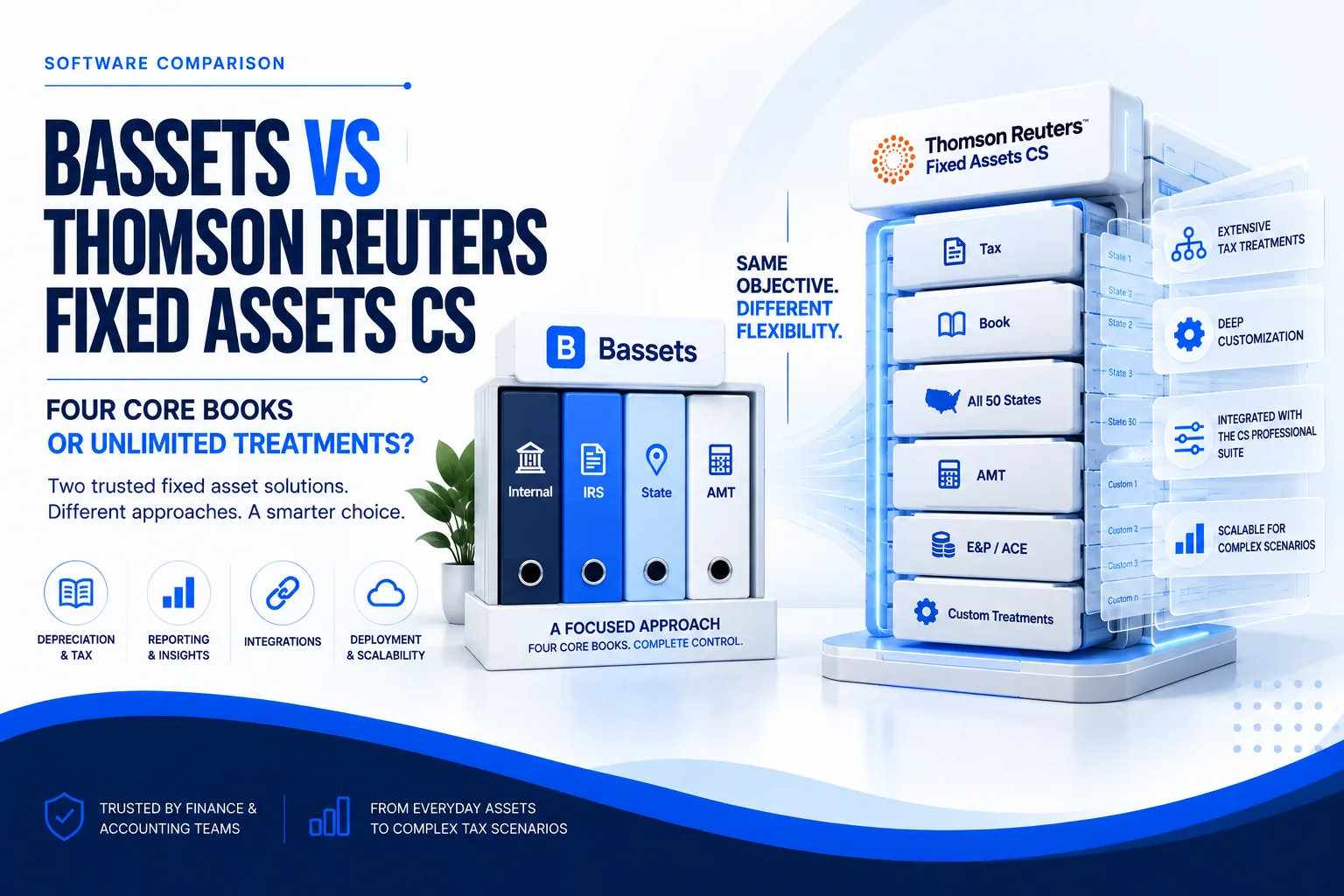
If you operate in non-conforming states, your fixed asset software needs to maintain parallel schedules. At minimum, you need:
- Book depreciation (GAAP or management reporting)
- Federal tax depreciation (with bonus and Section 179 elections)
- State tax depreciation for each non-conforming jurisdiction
Now is the time to verify that your state depreciation calculations are current and that additions and subtractions reconcile to your federal schedules.
There's a New Depreciation Category You Should Know About
Grassi's article mentions the 100% deduction for Qualified Production Property (QPP) created by OBBBA. This new category covers nonresidential real property primarily used for manufacturing, and it qualifies for full first-year expensing.
For QPP eligibility, construction must begin after January 19, 2025, and the property must be placed in service before January 1, 2031. The property must be primarily used for manufacturing or production activities.
Get the Classification Right Now, Or Pay for It Later
Determining whether a building qualifies as QPP requires documenting its primary use. Your fixed asset records should capture usage allocations, tenant information for multi-use facilities, and construction timeline evidence.
Before year-end, review any 2025 construction projects or building acquisitions to assess QPP eligibility. Misclassification discovered during an audit could result in significant depreciation recapture.
Your Fixed Assets Play a Big Role in QBI
Grassi addresses the Qualified Business Income (QBI) deduction and its permanent extension under OBBBA. They correctly note that pass-through owners should evaluate how income and compensation decisions affect the 20% QBI deduction.
What the article does not cover is the role of fixed assets in QBI calculations. The deduction is limited to 50% of W-2 wages or 25% of W-2 wages plus 2.5% of the unadjusted basis of qualified property.
Unadjusted Basis Matters More Than You Realize
Qualified property for QBI purposes means depreciable property held at year-end that is used in producing qualified business income. The unadjusted basis is the original cost before any depreciation deductions.
Your fixed asset software must retain original basis information even as accumulated depreciation grows. Some systems overwrite this data during adjustments, and that creates problems when calculating the QBI limitation.
When Was the Last Time You Actually Counted Your Assets?
The Grassi article focuses on tax planning strategies but assumes your underlying asset records are accurate. For many companies, year-end provides the only opportunity to verify that the fixed asset register matches physical reality.
Industry research consistently shows that 30% or more of fixed asset register data does not align with actual assets on site. Ghost assets continue generating depreciation expense. Missing assets receive no coverage in property insurance.
A Quick Physical Inventory Could Save Your Deductions
Before finalizing your depreciation calculations, conduct a physical inventory to confirm:
- Assets listed in the register actually exist
- Asset locations match recorded data
- Disposed or retired assets have been removed from active depreciation
- New additions have proper documentation and correct placed-in-service dates
Claiming depreciation on assets no longer in service creates audit risk. The time to identify and correct these discrepancies is before year-end, not during an IRS examination.
Planning Energy Projects? The Clock Is Ticking.
Grassi mentions that several clean energy incentives begin phasing down in 2026. OBBBA accelerates the expiration of many Inflation Reduction Act credits, affecting solar, wind, and energy-efficient building projects.
If you have planned energy-related capital expenditures, the year-end decision involves more than just tax rates. It involves whether the credit will exist at all for future projects.
Document Your Construction Start Dates Now
For solar and wind energy credits, construction must generally begin by July 4, 2026, or the project must be completed by December 31, 2027. The IRS has specific rules for establishing construction commencement.
Your fixed asset records should capture construction start dates, progress milestones, and expenditure timing. This documentation supports credit eligibility if challenged during audit.
Good News If You Have Software Development Costs
OBBBA restored immediate expensing for domestic research and experimentation (R&E) expenditures. The Grassi article does not specifically address this provision, but it has significant fixed asset implications.
Under the prior TCJA rules, domestic R&E costs had to be capitalized and amortized over five years. Many companies created fixed asset records for these capitalized costs. The OBBBA change allows immediate deduction going forward.
Take Another Look at Your Software Cost Classifications
Software development costs often qualify as R&E expenditures. Year-end is the right time to review your capitalization policies for software projects and determine whether costs should be expensed or capitalized under the new rules.
Small businesses can retroactively deduct R&E costs that were capitalized in 2022 through 2024. Your fixed asset software needs to track these prior capitalizations to support the amended return calculations.
Here's Your Year-End Fixed Asset Checklist
The strategies Grassi outlines work best when supported by accurate fixed asset records. Here's a practical checklist for year-end preparation:
- Verify acquisition dates and placed-in-service dates for all 2025 additions
- Run depreciation projections for Section 179 and bonus optimization
- Confirm state depreciation schedules are current and reconciled
- Review construction projects for QPP classification eligibility
- Calculate QBI qualified property basis from unadjusted cost records
- Conduct physical inventory to identify ghost assets and undocumented additions
- Document energy credit eligibility timing for planned projects
- Review software development costs for R&E expensing treatment
What This Means for Your Finance Team
The Grassi Advisors article provides an excellent overview of year-end tax planning considerations under OBBBA. Their guidance on charitable giving, SALT deductions, retirement contributions, and business credits gives finance professionals a solid framework for action.
What their article necessarily assumes is that the underlying asset data supports these calculations. For organizations with significant fixed asset portfolios, year-end planning success depends on having depreciation schedules that are accurate, complete, and defensible.
Whether your goal is maximizing bonus depreciation, optimizing Section 179 elections, or supporting QBI deduction calculations, the data foundation matters. Spreadsheet-based tracking becomes increasingly risky as compliance requirements multiply under OBBBA.
FAQs
When Should You Start Year-End Tax Planning?
Effective year-end tax planning should begin in October or early November. This provides sufficient time to run projections, evaluate strategies, and execute transactions before December 31 deadlines. Waiting until mid-December limits your options and increases the risk of errors.
What Exactly Is Year-End Tax Planning?
Year-end tax planning involves reviewing your financial situation before December 31 to identify strategies that can reduce your current-year tax liability. For businesses, this includes evaluating depreciation elections, timing asset purchases, making retirement contributions, and ensuring compliance with state and federal requirements.
How Can You Reduce Taxable Income Before Year-End?
Businesses can reduce taxable income by accelerating deductible expenses, maximizing retirement plan contributions, making charitable donations, and taking advantage of depreciation provisions like Section 179 and bonus depreciation. For fixed assets, ensuring equipment is placed in service before December 31 can generate significant first-year deductions.
What Is Section 179 Depreciation and How Does It Work?
Section 179 allows businesses to immediately deduct the full cost of qualifying equipment and property in the year placed in service, rather than depreciating it over multiple years. For 2026, the deduction limit is approximately $2.56 million with a phase-out beginning at $4.09 million in total qualifying purchases.
How Does Bonus Depreciation Work for Businesses in 2026?
Under OBBBA, bonus depreciation returns to 100% for qualifying property acquired and placed in service after January 19, 2025. This allows businesses to deduct the entire cost of eligible assets in the year placed in service. The property must have a recovery period of 20 years or less and meet specific acquisition timing requirements.